

Hey, would you do me a favor? I’m partnering with Typeform to do a study about what people in tech think of being a manager vs. staying an IC. I’d love to get your perspective! Please share your thoughts →
Everyone wants to be a content creator these days. Or an influencer. Or, if you speak LinkedIn, a thought leader. Personally, the last 2 give me the ick - please never ever call me an influencer.
I get it. Attention feels good. Likes, comments, reposts, follower counts. They all scratch something in our fragile, validation-seeking egos. We live in the attention economy, after all. And to be fair, I’ve encouraged plenty of people to start posting or writing. I genuinely think more people should share what they know.
What I don’t think people see is what it’s actually like on the other side. So if you’ve ever thought about putting yourself out there, here’s how it worked for me (and what no one tells you about being a ‘creator’).
Sponsored by (one of my faves!) Firecrawl: Firecrawl is the web data API to search, scrape, and interact with the web at scale. Turn the live web into clean, structured data your agents can actually use. Give them a try!
My personal story
Why I started ‘creating content’
I didn’t start creating content because I want to become some sort of influencer (puke). In fact, if your motivation is to become an influencer, please just don’t.
For me, it actually started after I was a guest on Reforge a few times. It hit me how much valuable knowledge is trapped inside companies. Every team is figuring out things that would help hundreds of other teams, but the lessons are never outside the org. Sometimes they don’t even make it past the team that learned them - they just stay locked away in Slack threads, Notion docs, and people’s heads.
Instead, what does get shared in public is a lot of nonsense. So many people posting online have never actually done the job. They’re throwing out generic career advice or recycled frameworks that sound profound but fall apart the moment you actually try to apply them, much less scale them. (If I see one more post saying the secret to career success is ‘having a great manager’ with 10,000 likes, I might blow a gasket.)
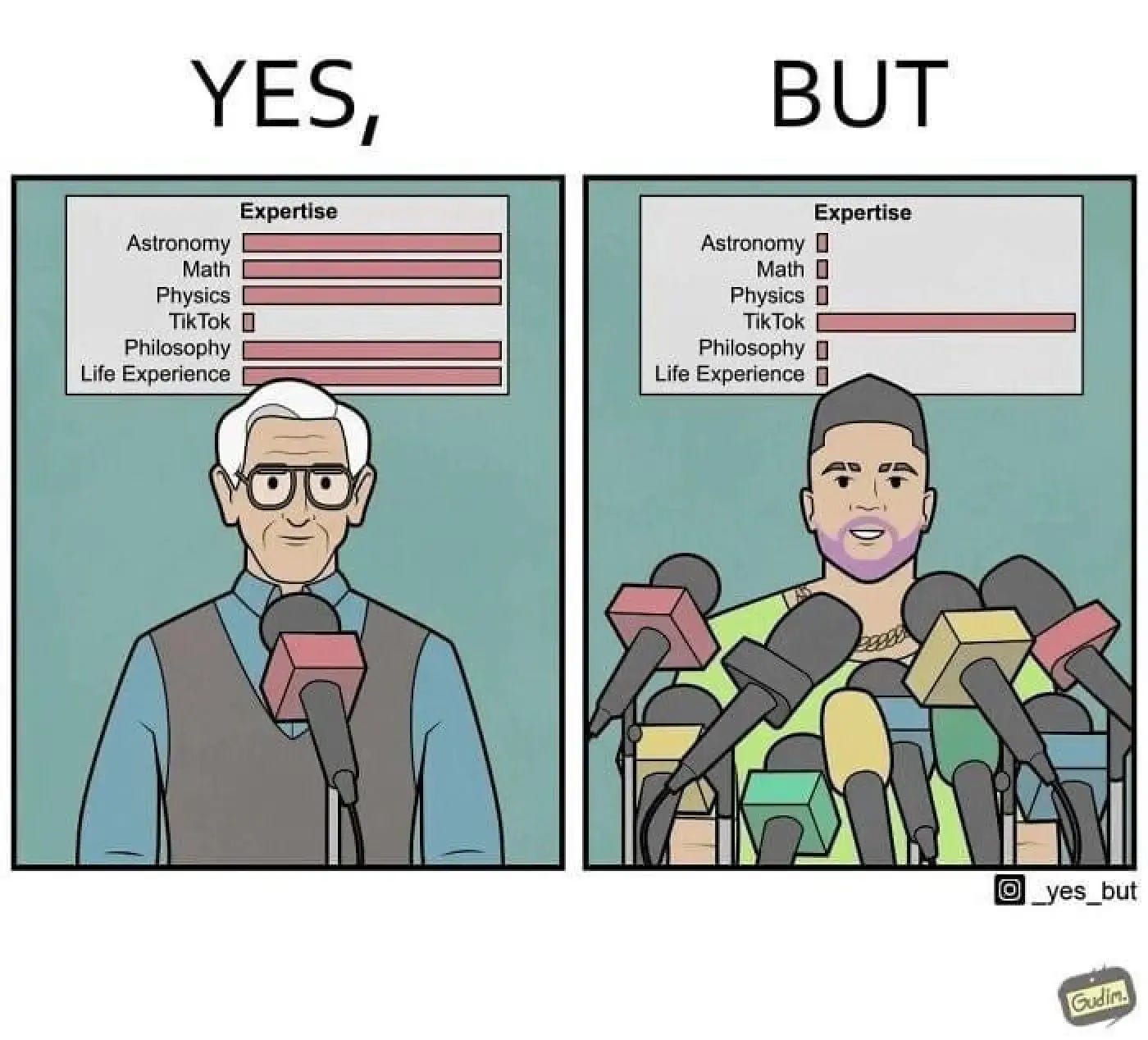
That feeling only got stronger once I started advising startups. I was shocked by how similar everyone’s problems were. Different companies, different industries, different stages... but they were all struggling with the exact same growth, product, and organizational challenges. It was almost demoralizing. Why are we all separately relearning the same lessons instead of sharing what works, what doesn’t, and why? We’d make progress so much faster if we spent less time rediscovering the basics and more time solving the next generation of problems.
Mistakes like, for example: Not paying attention to activation. Swinging over to enterprise too early if you’re B2B. And over-focusing on how your homepage looks when it doesn’t even f#*%ing matter.
So my content creation journey started with: ‘Hey, I have thoughts. I have years of experience. They actually have some pretty cool patterns in them. Some of them are right, some are wrong, some don’t apply to everybody, some do. Why don’t I just start sharing them?’
How I started: LinkedIn
Twitter/X was a hot mess express at the time (maybe still is, ha), so I figured LinkedIn was the way to go.
I started with just bite-sized pieces of content. My posting rules were very simple: If I said or shared something 3 times in normal conversations, I was just going to post about it.
Another rule came from Brian Balfour, which I still use to this day. He said the content that performs best falls into two buckets. One, it’s a contrarian take. Two, it’s a pattern. A contrarian take works because you’re basically saying what everybody is thinking but isn’t willing to say, or maybe hasn’t even recognized is true. It’s provocative, so it gets people talking! Patterns also work because our brains loooove recognizing patterns.
So I started with just that - little pattern frameworks created and screenshot from Miro boards, a couple of thoughts, and that’s it.
I started with almost no engagement (as in: 20 likes = BIG deal) and maybe posting once a week. And I kept it in my own voice, with my own typos. I was just trying to share, not go viral.
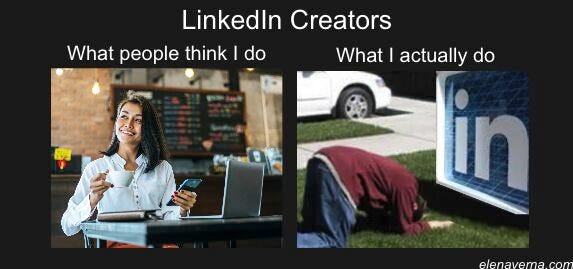
At first, it felt like the same three people were always liking and commenting on my posts. I felt like this guy:
I quickly realized that my ‘superpower’ was around product-led growth - I had so many nuggets to share that came so naturally. And people reacted! My follower count grew from a few thousand connections to 40K in a year.
Then one day I created a meme. And it blew up.
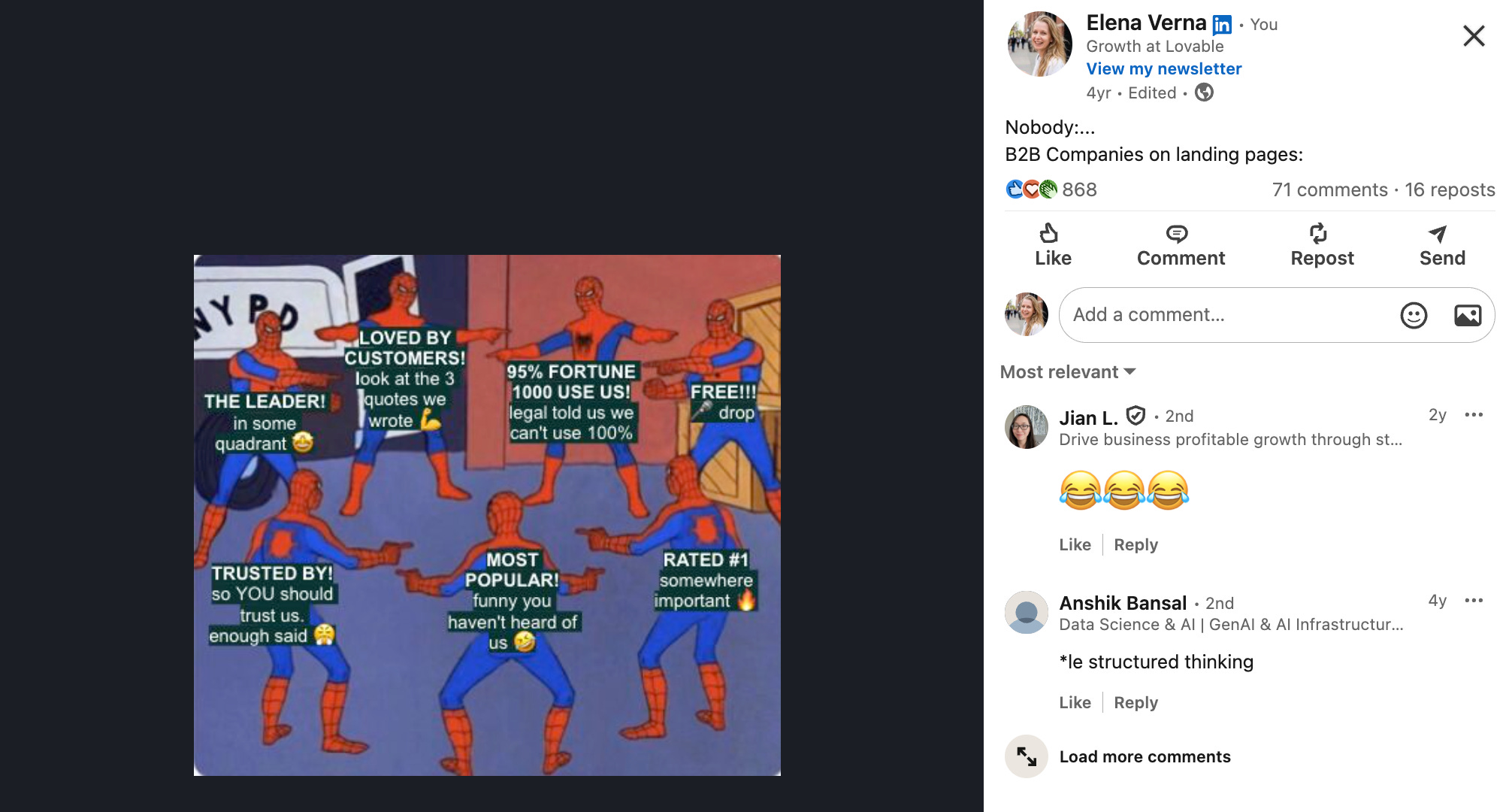
So just like that, memes became A Thing for me. And really it’s just another form of pattern recognition attached to a picture. I noticed people tend to digest hard truths better in meme form than just through words. A picture is worth a thousand words, they say :)
I always posted about what I’m working on or involved in, so as my career and interests shifted, I gradually added things like product-led sales, career optionality, and now (of course) AI.
Cone of shame moment: there was a period where I got caught up chasing impressions. I made it onto LinkedIn Lunatics once (or twice), which is both embarrassing and probably a necessary awakening step in everybody’s social posting game.
In my defense, all of the social platforms are optimized to make you addicted. Most people talk about the consumption/scrolling side, but this is true on the creation/posting side too. When you’re on them a lot, they pull you into wanting to chase impressions, chase likes, chase that juicy dopamine hit.
I have this addiction reasonably under control now (do I?), but I still have to constantly remind myself that impressions are not the same as impact. My north star isn’t followers, likes, or views. It’s making a meaningful contribution to the space.
Not every post will land: some will flop and some will miss the mark entirely. That’s part of putting ideas out into the world. As long as, on average, I’m contributing more signal than noise, I’m ok.
How it’s going: this newsletter
About 2 years in, people kept asking me, ‘Do you have a blog? Do you have somewhere these insights live that’s more than just bite-sized frameworks? Somewhere with deep-dives on the problems and solutions?’
At first I pushed back. I was like, ‘Listen, Lenny already exists. The world does not need another blog.’ But people kept pushing me. I felt like the market was pulling me into it.
So I started this Substack. Especially because I’ve seen so many social media platforms start to lock down distribution, I wanted to be able to ‘own’ my distribution, even if the mighty social algorithm changed.
It ended up being pretty successful. I’m almost at 100,000 subscribers on Substack:
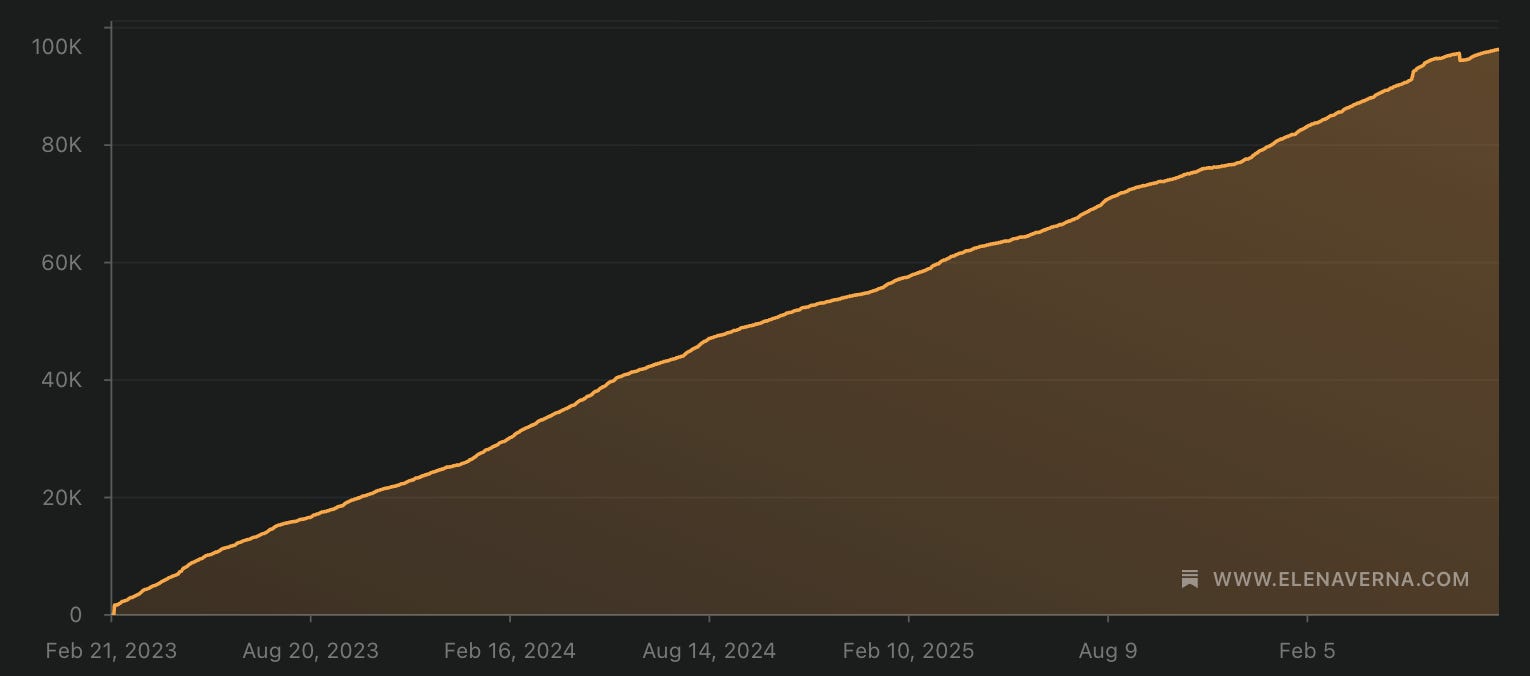
and ~230,000 on LinkedIn. I mean… this is what 100K people looks like IRL..

WHUT. I’m sorry, but my mind cannot comprehend this. It’s absolutely crazy. I’m so thankful to every single one of you. Really.
And even though it wasn’t my initial goal, I’ve been able to figure out a good monetization system for my content, too (I’m a growth person, what did you expect!?). I make every new newsletter edition free, and then ask people to pay a monthly subscriber fee if they want access to the archive of past posts. (If you’re one of those 1000+ paid subs - thank you! It really means more than you know.) Also: I mostly ungate the career-focused stuff, because I really want everyone to have access to that.
And (of course) companies also started reaching out asking to buy sponsorship slots on the newsletter (which, believe it or not, sells for thousands of dollars per issue). I’ve chosen to only work with companies where I personally use and endorse the product, or at least am trying it out for myself, so that I’m only sharing stuff with my readers that I really think they should try. So it feels like a win for everyone.
Lastly, I have an amazing editor who helps me turn my ideas into long-form content. My superpower has always been short-form thoughts and verbal rants, not structured essays - especially since English is my second language. I feel incredibly lucky that Jonathan Yagel reached out one day and offered to help (my grammar mistakes and broken sentence structures must have burned his eyes). He’s become my partner in crime, taking my stream of consciousness and somehow turning it into something coherent that people actually want to read. Every piece still goes through my final pass, but he saves me days compared to writing everything from scratch.
The good & The bad
I’m grateful that the content creation stream has created an additional income stream that has given me even more career optionality. I’m at the point where I make more from my solopreneur activities (content, advising, etc) than my full-time salary, which is the type of career optionality that I’ve always been very keen on and something I advise everybody else to do as well.
However, the best part is when I go speak at conferences and people come up to me and say, ‘Hey Elena, this post you wrote changed the whole direction of my career,’ or ‘You helped me get a promotion,’ or ‘I got into growth because of you and I love it.’ It warms my heart to hear that stuff I’m sharing is having a positive impact on people’s careers and lives. Honestly, that's what this is ALL about. Building shareholder value is great, but nothing compares to knowing you've made a positive impact on someone's life.
But there are also negative sides to it.
For one, creating content can turn into a grind. It can start feeling like you’re on a schedule. It stops being a creative or free or fun process. I still mostly publish based on when I feel like I have something that I’m excited to share, but I have a sense of obligation to both paid subscribers and sponsors to post on a certain cadence. If you’ve ever tried to turn something you love into something you have to do on a schedule, you know what I mean.
Another downside isn't as obvious. The more people who read your work, the more likely someone will make it their mission to point out what you got wrong and dump on you. Sometimes they're right, and that's valuable. But often it feels less like a discussion and more like a game of finding flaws. That can be surprisingly draining.
Maybe a blatant disclaimer would be helpful?
DISCLAIMER: I am just one person, sharing her opinion. I do not have a team of analysts or corporate comms to check everything. I am almost definitely wrong about some of the stuff I say. My opinion is subject to change. This is not legal advice, investment advice, or anything else except hopefully some perspective that you may not have considered before.
I want to challenge how people think and I’m glad when they do the same for me.
What sucks is how personal it gets: People make confident claims about my motivations. They try to crap on my professional experience to show that I don’t know what I’m talking about. And just generally say hateful things about me as a person. Some people seem to make attacking others into a personal hobby.
This gets even worse when you’re doing long-form writing. It seems like the people who are most enraged by stuff I write … often haven’t read it. Maybe they see a headline or see someone else’s description, or maybe got an AI summary. And I know everyone’s time is limited and attention spans are short, but it’s wild to have someone yell a claim at you in a comment on an article where you made that exact claim, just because maybe it was below the fold in the article?
(Maybe I should have easter eggs in my content: ‘If this makes you mad and you want me to know why I’m wrong, be sure to use codeword `Banana` in your comment, so I’ll know you read this far,’ haha)
And that gets really hard to deal with. In fact, I’ll be taking August off to recharge. I need to step away for a bit and find the motivation to write again.
The third hard thing is that my writing is all anchored in my own experiences. Because of that, it naturally drifts depending on what I’m working on at the time. And people don’t always like that.
For example, people say I post too much about AI, or they call me an AI slop farmer, or a sellout because I talk about Lovable so much. But… Lovable is my experience right now. That’s my life. It consumes a huge percent of my awake hours every day, so yeah, I’m going to talk about it a lot. It’s what I spend most of my time thinking about. I’m an operator at this company.
If you’re going to follow my operator/creator path (which I think is the best way to make content, btw), you’ll have to figure this out, too. Keeping your day job helps to anchor your stuff with real experience, but some people see talking about your own company as a conflict of interest.
Every company I’ve been at (unless they explicitly told me I couldn’t post about it, which has actually happened a number of times, lol) I’ve talked about what the product does and how people could or should use it. That’s what I’m thinking about 24/7, so it naturally factors into my writing.
People don’t always like that because they have a version of me in their heads. They want me to fit into a particular mold they’ve created. The more people see your stuff, the less you get to control whether their perception matches reality.
Another negative is having your views on display in real time, even as they’re developing. This is kind of like how I pity the kids these days who are having their thoughts and still-developing opinions recorded on social media forever. Thank goodness my AIM status updates have disappeared into the void, because I wouldn’t want anyone to see my teenage hot-takes, now.
But when you’re sharing your opinions in public and your entire role, job function, AND industry are getting flipped upside down, your opinions will probably change. And for some reason, some people on the Internet treat that as an act of hypocrisy or high treason.
Plus, there’s just the general weirdness that comes with being more visible to more people. Once you cast your net far enough, you inevitably get creepy people in your DMs. That’s just something you have to ignore and develop a thick skin against.
Tips for you
My #1 tip for people who are considering creating more content is: Respond to comments! If someone took the time to read your stuff and share their thought, you should engage with them. And that’s a policy that I’ve maintained since the beginning - and if you stop wanting to engage with people who read your stuff, then what are you really posting for?
My #2 tip: Just be unapologetically yourself! Your goal isn’t to go viral. It’s to find your people. Forget the algorithm, the rules, and the ‘best’ posting frequency. It’s the only strategy that’s sustainable, because trying to fit some mold will not only feel exhausting, but will also feel forced and quickly gross.
My #3 tip: Find what you want to be known for. Just like companies need product-market fit, creators need creator-market fit. You can’t be everything to everyone. What’s your specialty? What’s your unique knowledge? What’s the perspective only you can bring? Find an underserved niche, solve a real problem, and keep showing up for those people. The goal isn’t to appeal to everyone. It’s to become valuable to someone.
So… if you’re thinking about starting your own creator journey, I’d still recommend it. As I said 6 months ago (feels like a lifetime): Companies are going to continue to treat follower counts as a factor in hiring decisions. And for certain solopreneurship paths, it’s not something you can totally avoid. Public credibility is a big deal in generating business pipeline.
But if you do: Just go in with your eyes open. If you go in for the right reasons, it will change your life. If you go in for the wrong reasons, I guess it will change your life too, but it won’t be worth it.
Thanks for reading. Always.
Edited by Jonathan Yagel.
Valuable as always. Love the real real rather than only the sugar coated.
Plus it’s what I am experiencing, helpful with my soloprenuership growth, I really enjoy putting together a meaningful post and the value people get from it, but the grind and schedule is daunting to keep up with.
I needed to stop talking about AI, it’s something I work with daily, and just write about a trip because it gave me joy to “paint with words” rather than than post another how to.
I avoided writing anything online for a long time because I was afraid of receiving criticism for changing my mind, being wrong about something, or even just using British English instead of American English. 😅
But there are things I want to say, and eventually I realised I just have to write. I convinced myself that I don’t care anymore haha.
Anyway, it was really nice to read such a personal take on writing, so thank you for sharing!