


Hi everyone - Most of you are Growth or product people, which means that one of your closest collaborators is probably: Product Marketing. As I’m seeing roles start to merge and overlap, this is an area you should definitely be aware of. What are AI-native PMMs doing and how can you collaborate best with them? What skills do they have that you should maybe learn? I asked our incredible Core PMM from Lovable, Gemma Casey-Swift, to write this guest post to fill you in. Enjoy! - Elena
How product marketing works these days is unrecognizable from even a few months ago.
Some of it’s the available AI tools, some of it’s the speed of feature releases, some of it’s the shifting job roles. But if you’re trying to launch products in late-April 2026 (it may be different next week!), please reconsider what you think you know about PMM.
One of the biggest changes? Product Marketers used to be a bottleneck. Building a lot of elaborate processes (yes, I said the p-word, I’m sorry) that seemed like they were slowing things down.
Now? Well, now the PMM team is a crucial part of helping your org go fast. Here are a few key ways that product marketing at Lovable has built foundations that the rest of our team needs.
(If you’re a Growth or Product person… hey, friends! Send this to your PMM to make sure they’re tracking. But also maybe read it yourself? Spoiler alert: The more you can do your own product marketing, the faster your career and company will grow.)
Let’s do this!
Elena’s Picks
Hey, I’m trying out a new format for my sponsors! I’ll be specifically recommending products and services I personally use and love.

→ Stripe: Ideal for payment processing and all-things monetization.
I’m giving a talk at their big conference, Stripe Sessions… tomorrow! I’ll be sharing how Lovable turned monetization into a growth lever. Come check it out!
🎁 Come hang out: Register for Stripe Sessions.
→ Customer.io: Ideal for highly-targeted email campaigns based on user behavior.
We use them at Lovable and I’m a huge fan. It’s so flexible and intuitive to use that, before we had our first email marketer, anyone on our team could launch an email campaign! And it was actually cohesive. Now that we do have an email marketer, they’re doing amazing things with it. A product that can serve varying degrees of experience like that is so hard - but Customer.io has nailed it.
👀 Check it out: Learn more.
→ Lovable: What can I say? Yes, I work here. But… I work here because I was obsessed with the product, first. It’s the best way to build an app or site, even if you have no technical experience. Try it out!
🎁 Offer: Get a year of Lovable for free! (For paid subscribers to Growth Scoop)
1 - Enable your team to launch stuff, themselves (vs. expecting everything to go through you)
This is probably the biggest switch. The reality is that we are launching updates wayyy too fast for a traditional PMM-driven launch cadence. In old school companies, you’d have a big Tier 1 launch at your user conference… once a year? Maybe twice if you’re aggressive.
Now, we launch updates that could be tier 1 almost every other week. So, how do we keep up this pace? Definitely not by making everything come through PMM every time. If we did that, we’d always be the bottleneck.
So, instead, we built out the infrastructure to help our team launch stuff on their own.
We tiered launches into a few main buckets:
Big launches (still Tier 1): These are still big releases (or round-ups of multiple releases) with big moments and active coordination across the teams. Marketing still runs these.
Tier 2: Still run by product marketing alongside a PM but generally more fluid with a more flexible bill of materials. We often amplify these further post-announcement if the launch is getting good traction.
Everything else: If it’s not specifically designated for a tier 1 or tier 2 launch, the people building it launch it themselves. Our job as the product marketers is to give everyone the resources they need to do this.
This is the key to going fast. The whole point is to create a culture where people are encouraged to launch their own stuff without PMM being precious. You lose a little messaging control, but you gain momentum. And honestly, some of the content our eng and product team shares goes more viral than any perfectly curated post ever could.
Elena Note: I want to add: Not only does our PMM team enable our builders to launch stuff… they also build their own stuff to launch! Our shiny new Lovable Academy was created entirely by the PMM team. Because product marketers have such a deep understanding of the customer, they’re often the perfect people to build out these kinds of Satellite Apps.
So, what kind of infrastructure are we actually building?
2 - Define your ICP based on actual data (vs. based on brainstorming or wishful thinking)
Providing a clear, consistent Ideal Customer Profile (ICP) is one of the most valuable things a PMM team can provide to their organization. Unfortunately, most of these are all over the place and based on some hand-wavy hypotheticals.
Now, no one has time for an ICP that doesn’t drive value.
How do you get that? The good news is that this profile actually already exists. It’s just buried in your CRM, usage data, support tickets, and that spreadsheet someone in sales has been carefully maintaining.
Here’s how we pull the data with help from our awesome insights team:
Product data: We dug into usage, retention, ARR, and conversion across the full user base.
Builder surveys: Captured roles, needs, decision-making, and “definition of done.” Paired responses tracking expectations vs. outcomes across a build cycle.
Deep-dive interviews: Tapped further into what people were building, why, their emotional state, workflows, needs, struggles, and dreams.
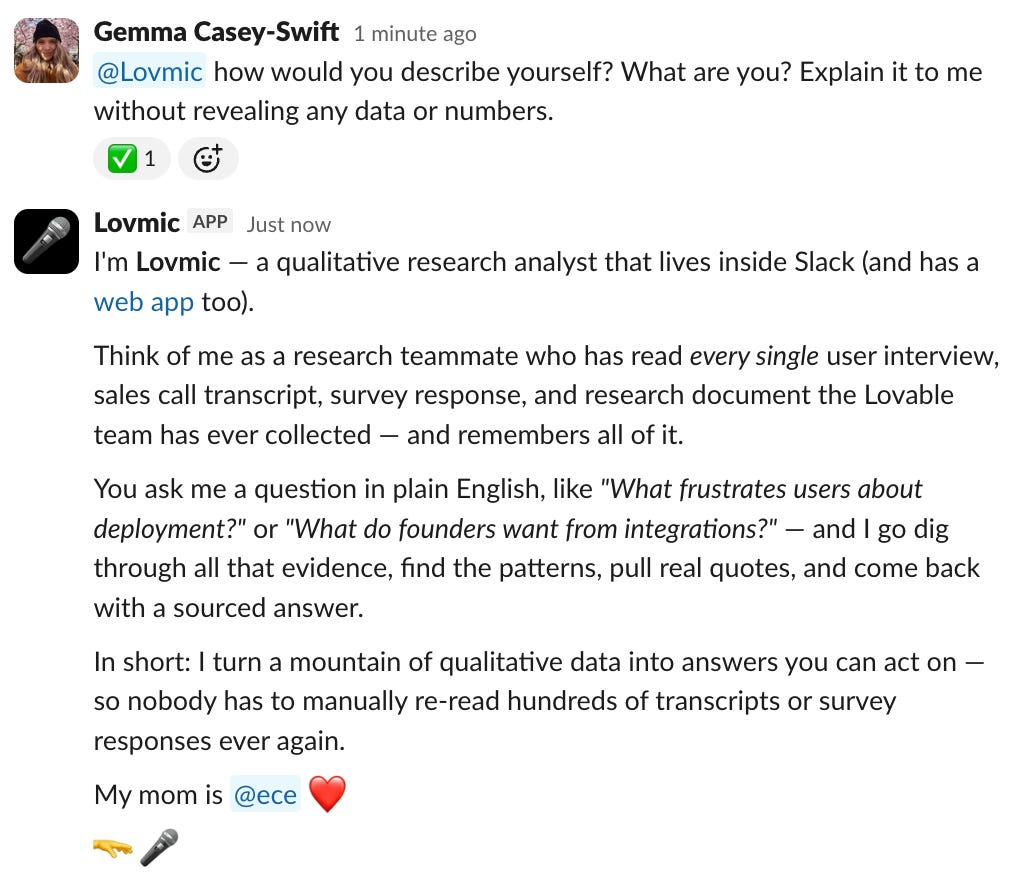
Internal AI agents (built on Lovable, live in Slack): Built by our insights team and connected to our full library of user calls, surveys, and interviews. We ask questions in natural language and get back themes, quotes, and patterns on demand.
The biggest shift for me was realizing our ICP is genuinely “everyone,” and you can’t ignore that.
My old instinct was to narrow: pick one persona, one segment, one use case, and aim everything at them. But when the product is category-defining and/or general-purpose, demand can show up from solo-builders to huge enterprises all at once. Even if this makes product marketing and prioritization hard, you can’t ignore clear signals.
This is also why ICP reviews can’t be an annual ritual anymore. PMMs traditionally set an ICP in January, build a deck, and let it calcify. That cadence won’t work today. We review which segments are growing, converting, expanding, and churning weekly. Most quarters there’s a small adjustment. Some quarters there’s a real one, and catching it early changes what marketing, product, and sales should be doing right now.
Naming the ICP is one thing, the actual job is making the rest of the company move with it. PMM is constantly refreshing core messaging, channel mixes, targeting and talk tracks.
We package ICP insights into clear updates and make the rounds on Slack channels, all-hands, team meetings, 1:1s with leads, etc.
3 - Constantly interview customers (not just to start, or when you’re forced to)
Most product marketing teams either rely on other teams to gather direct customer feedback… or they just don’t get it at all. But if you’re going to build fast and launch fast, you need to be talking to your customers a LOT. Do not let sales or CS block you (this was the bane of my life for years).
When I joined, me and our Growth PMM immediately linked arms and packed our calendars with back-to-back interviews. We went to every team and asked them a million questions about our users.
On each customer call, we asked the same five questions every time:
“What were you trying to do when you found us?”
“What did you try before Lovable?”
“Walk me through the moment you decided to sign up.”
“What almost stopped you from using it?”
“How do you describe Lovable to other people?”
We recorded everything (with permission) and looked at trends and patterns.
This kind of information is the lifeblood for any product-based business. Having real-time feedback on what’s working and what’s not helps everyone go faster. So, what were the pain points that users mentioned?
“Hiring developers is expensive and slow”
“I tried no-code tools but hit limits immediately”
“I’m not technical but I have ideas”
And it wasn’t just the themes. A big part was making note of the exact language they used:
“It gives me superpowers” (not “it writes my code”)
“I had a working prototype by lunch” (outcome-focused, time-specific)
“Finally something that just works” (cognitive ease)
And the moments they got excited about:
Watching their ideas come to life before their eyes for the first time
When they shared what they built and someone said “You built this?!”
When they realized they didn’t need to hire anyone
When something they thought would take weeks took 20 minutes
And the questions that kept coming up:
“Is this actually production-ready?”
“How do I work with my brand?”
“Can I export the code?”
Back in the day, these insights would probably just sit in a doc. Now, they’re powering tools that every team at Lovable can use, including:
An interactive messaging house (built in Lovable, naturally). We took the core messaging and turned it into a living document inside a Lovable app. Not a deck. Not a Notion page that goes stale in a week. An interactive messaging house anyone in the company can navigate, search, and pull from by audience, by archetype, or by use case.
An AI research assistant. Remember the agent I mentioned earlier? Our data scientists built it so anyone at Lovable can just ask things like “How do solo-founders describe the product?” or “What’s the #1 frustration for small teams shipping to production?” and get insights from every interview, survey, and call we have on file.
This means every team can get more accurate, higher-quality context when trying to communicate with current or potential customers. For me, when I was writing landing page copy a few days later, I literally pulled exact phrases:
Landing page headline: “Ship your ideas in days, not months” (exact phrase from user interview)
Social proof: “I’m not technical but I have ideas—Lovable is perfect for people like me” (real quote)
Campaign copy: Added “Your co-founder doesn’t just build, it runs the business with you” (based on how people were describing the product)
4 - Create a simplified messaging framework (vs. making everyone invent messaging from scratch OR read an exhaustive 25-page treatise)
Does your company have a central source for messaging? When I joined, I asked about this… and it turns out one existed from a few months prior but no one remembered what it said.
You’ve probably seen it before: The PMM team beats everyone over the head with messaging documents that are constantly updated and also dozens of pages long, full of details that seem oddly specific and still somehow hard to understand.
But it never hurts to start over, especially if you’re new. I asked everyone on the team: “Show me how you describe what we do.” And that led me to:
Pitch decks (multiple versions)
A bunch of different Google docs
Landing page copy (homepage, pricing, feature pages)
Email templates
Links to tons of social content and videos
Customer-facing help docs
Interview recordings
A bunch of deep Slack threads
And we started looking at the patterns:
People didn’t see Lovable as a coding tool - it was becoming a “full co-founder”
Everyone mentioned speed (“fast,” “10x,” “minutes not months”)
Split on whether to lead with AI or outcomes
Technical teams said “full-stack apps,” non-technical teams said “just describe what you want”
Which also forced us to consider some unresolved conflicts:
How technical are our audience really?
What do they really want?
Is the magic the AI or the speed?
Are we selling software or selling outcomes?
After some hard conversations, I was able to build a single messaging hierarchy with our core positioning, messaging variants for technical and non-technical users, use cases, and proof points. And again, the thing that helps everyone go fast with this kind of thing is… actually getting access to it. So I presented it to key stakeholders, got feedback, adjusted, and circulated.
Within two weeks, people stopped asking “How should we describe what we do?” The marketing team updated copy across all of our channels. The product team echoes the same messaging in roadmap planning sessions. The founders reference it in company updates. Everyone’s able to move quickly, because they’re not having to build messaging from scratch every time.
BONUS: PUT IT WHERE THEY CAN ASK IT
One of the biggest time sucks for any organization is trying to find the right information. It’s all probably out there… it’s just scattered across Slack threads and Google Docs no one can find, or the PPT decks with “FINAL - Final Actual v2.8” in their titles. If you don’t know whether something is current or accurate, you can’t trust it. And none of the work PMM does matters if it’s buried.
The old version of fixing this was “put it where people can find it”. By that I mean creating and distributing single source of truth documents with links to relevant resources so the same question doesn’t get asked twenty times. That’s still table stakes, and it’s still one of the highest-leverage things a lot of PMMs aren’t doing.
But the bar is moving fast. The next version is “Put it where they can ask it.” Instead of hunting for the right doc, anyone in the org should be able to ask a question to an agent or LLM chatbot, in natural language: “What’s the messaging for the payments launch?” “Who’s our ICP for enterprise pilots?” “What are the top 10 most used features right now?” The goal is to be able to ask these questions and get an answer on demand, wherever they work.
We’re already running a network of specialized agents on Lovable, which are basically small company brains built to help people with specific areas of their work when they need it. Next up: a launch agent connected to our calendar, messaging briefs, and asset libraries, so anyone can ask about upcoming launches, find the information they need, and talk about it.
Conclusion: Product Marketing at ludicrous speed
So, who has time for product marketing? Turns out everyone does when product marketing starts thinking more like an infrastructure, not as a gatekeeper.
Providing a clear ICP grounded in real data, easy access to that live data, self-serve launches, and information that is findable, askable, and usable by anyone in the org. Done right, PMM stops being the team you wait on and starts being the team that makes everyone else faster.
If you’re a PMM reading this, throw out the parts of the playbook that were really about controlling work rather than enabling it. Build the foundations, then get out of the way.
If you’re a Growth or Product person reading this, your closest collaborator just became one of the highest-leverage people in your org, so don’t outsource product marketing thinking, borrow it. Sit in on customer calls, pull from the messaging doc, ask the research bot. The more you can do your own product marketing, the faster you (and your company) move.
PMM isn’t the bottleneck anymore. In an AI-native company, it’s one of the engines. so go find yours, or build the one your team’s been waiting for.
Want more from Gemma? Check out her awesome new substack:
Edited by Jonathan Yagel.
This is so good! Incredible insights
Thanks for sharing all these valuable insights! #4 is one of the biggest game changers as it really allows all the teammates to embrace messaging and to create a consistency across all channels. I'm doing a similar project in my company - would be curious to know what are the main use-cases the agent is used for.