

This post is brought to you by SIDEBAR: How do you continue to develop your potential... if you're exploring a unique career path? Sidebar is a personal board of advisors for top performers. Find out why 93% of members say that Sidebar has made a significant difference in their career trajectory.
I have a confession to make: I was a shitty manager.
I still remember it so clearly—I got promoted to a managerial role young, in my early 20s, as I was eager to climb the corporate ladder. I was excited about my career progression, but I also wanted to rebel against all things corporate: no work-about-work, no 1:1s, no check-ins. 'Come on, team! We’re going to do the best work of our lives! No meetings!' I figured we could line up a queue of work and just take it on.
The sad thing? I actually thought it was going great. Until one of my guys pulled me aside and asked: “How do I grow in my career, if we never have an opportunity to have 1:1s?”
That was like a slap in the face—here I was expecting that kind of guidance out of my manager yet not comprehending that I needed to give it to my team, too. Even if not all of the 1:1s I was having with my manager were that helpful, it was still a chance to manage up. But I wasn’t offering even that to my own team...
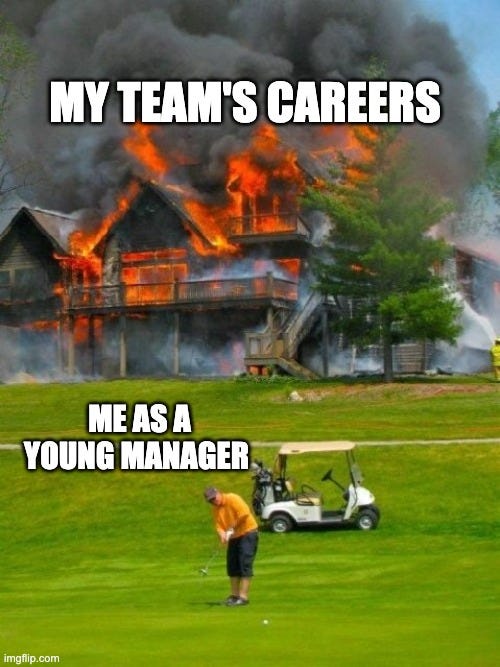
As I looked more closely, I also saw that my small team had started to drift apart and was starting to work in silos. So, wait… maybe we do need team meetings!? I found that some rituals are there for a reason. I do think my intentions were good: I just wanted to get shit done!
But even that was the least of m problems… I had incredibly hard time letting go of my IC work. Even at the Director level, I was still doing IC work: Filing Jira tickets, writing PRDs, writing SQL. As I’ve shared before, at one point, my amazing manager gave me an ultimatum:
‘If you want the next promotion, you need to stop doing so much of the work yourself. Your job is to lead, not do all of the individual contributor stuff. For the next 6 months, I’m going to review the logs… I want to be sure that you have not accessed the database, filed a Jira ticket, or created a PRD, yourself. You have to learn to delegate. You have to enable your team to do it. If you can do that, the next promotion is yours.’
Those 6 months were treacherous. Things I knew I could do in 3 minutes, would take me an hour to train, explain, and validate with someone else. But I’m grateful that happened because it ripped the bandaid off and I finally learned that doing it yourself is not the way to scale a team.
All of this was a decade and a half ago, and I’ll admit that I got better at it: Mainly because I had fantastic managers and finally learned to love mentoring people and helping them grow (instead of loving doing individual contributor, or IC, work myself). After that (emotional) slap in the face from my first report, I’ve seen so many times how guidance from a manager can shape a career and unlock potential. And I experience so much satisfaction in seeing someone who worked under me grow into larger, more impactful roles. That’s what I cling onto, to justify all of the pain of being a people manager.
Because, make no mistake, management roles come with a lot of pain. And I wouldn’t wish a manager role on my worst enemy.
Falling into the management trap
Unfortunately, many people see management as an inevitable part of a successful career. But as I learned the painful way, management is not just a title. It’s a skill—and not a particularly easy one. It’s definitely not everyone’s superpower. To make matters worse: the people who really want to be managers often shouldn’t be.
One of the major issues is that talent in your IC role has *no* correlation with talent as a manager. You’re a great data analyst? Amazing. Legendary designer? Beautiful. Top-tier dev? Fantastic. None of those have anything to do with what makes you a good manager.
Personally, if you don’t enjoy mentoring or solving people issues, I’m guessing you’ll find management to be a horrible job. Because that’s one of the things they don’t tell you: 70% (or more) of management is managing people problems, with 10% of your time being spent on every direct report you have. As one of my mentors once told me as he was scaling his team: “More people, more problems.” That’s exactly how I see it. Yes, you get to make those glorious leadership-level decisions and that fancy title, but most of the job is people issues & repeating strategy like a parrot. And don’t get me started that you have to absorb all of the blame if *anything* goes wrong (even if it’s not technically your fault).
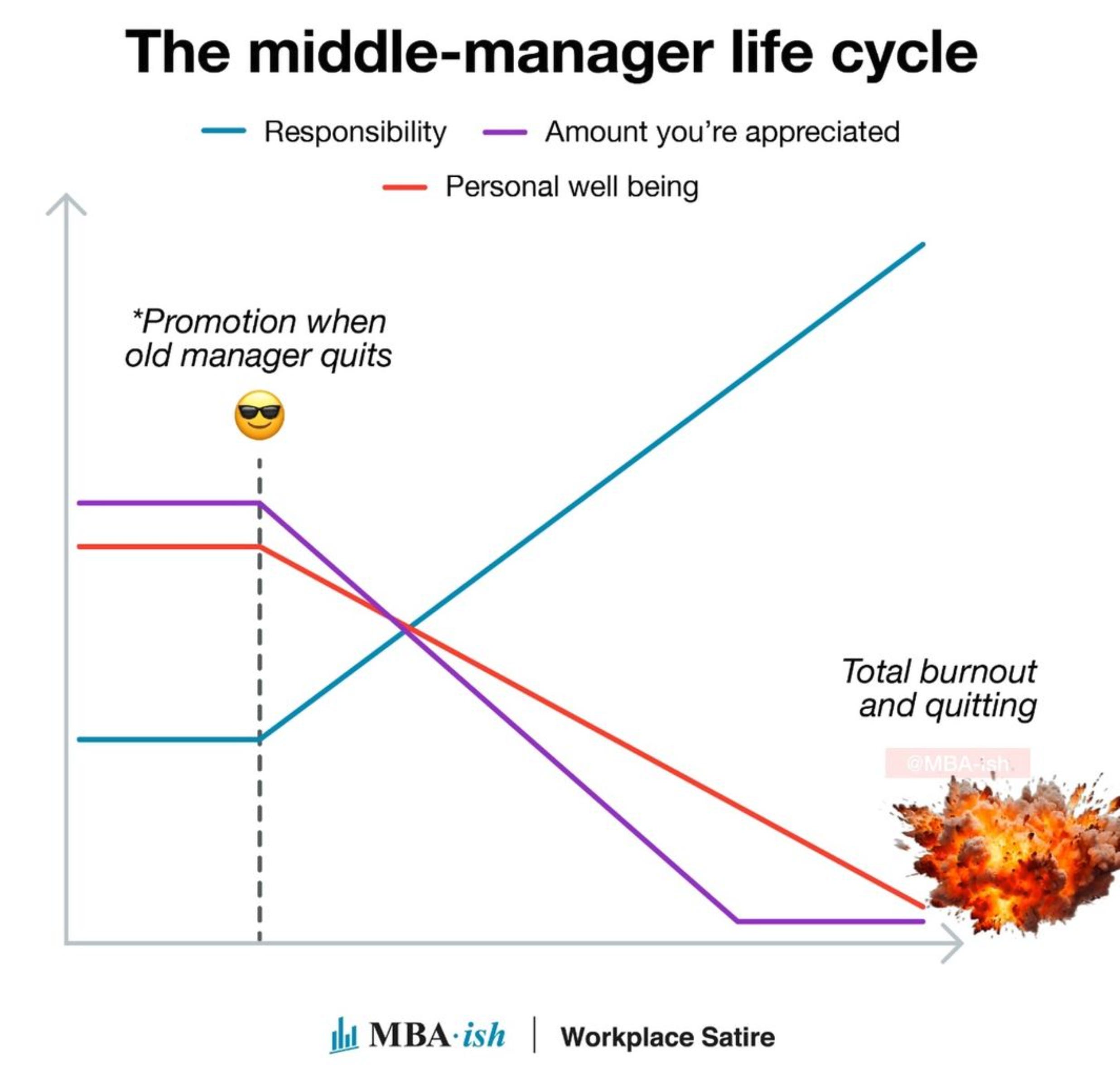
I do understand why people want to take manager path: The title, the money, the prestige. But there’s a dark side to it.
A different path: The Principal or Staff IC
So, what if you could keep doing the work you love, never have to manage people… and still advance in your career? I’m talking top-tier pay, prestige, and autonomy.
Is this a dream? Nope, it’s the ‘Principal’ IC path.
Fortunately, this is becoming more and more common: At Dropbox, we’ve recently hired a number of these types of roles, see example of the Staff PM here:

Staff (or Principle) Product Managers, Designers, Engineers and Architects (which are all IC roles)... are getting paid the same amount a Directors, or even VPs!
Examples of cash comps, which don’t even include bonus or equity:
Staff Product Manager - Up to $271K USD salary!
Staff Data Scientist - Up to $256k salary!
Staff Payment Specialist - Up to $243k salary!
(Note: One area I’m not seeing principal roles? Marketing. Maybe that will come at some point, but my hunch is that marketing has so many different specializations and sub-functions, which means senior marketers will almost always be required to manage other marketers.)
For anyone who doesn’t want to be a manager, this is a great path. It wasn’t that common 10 years ago and many people still aren’t aware it’s an option, so they don’t even consider it. But now that this is a possibility, I think it could completely change the game. If you can make the same salary on either path, there’s no longer a direct incentive to jump (or fall) into the management track.
This lets every employee play into their superpowers, which is good for them and good for their companies.
Another different path: Advising
What about if you are already in a traditional leadership or management role… but hate it?
Well, as you already know, this is what happened to me. And I wholeheartedly encourage you to try out advising!
I do need to be clear, here: Advising is not a good option if you’re not already in a leadership role. If you’re early in your career, put in the time to hone your craft and build your skillset. Over time, your abilities as a senior-level Principal IC will be in high demand and you can explore this route, but don’t try to skip the initial steps.
But if you do find yourself feeling trapped on the upper end of the corporate ladder, I’d encourage you to consider it. I found this to be another great way to escape the traditional framework, as I got a chance to be involved in the most important strategic projects for excellent companies, retained autonomy, and got paid well… all without needing to manage a team.
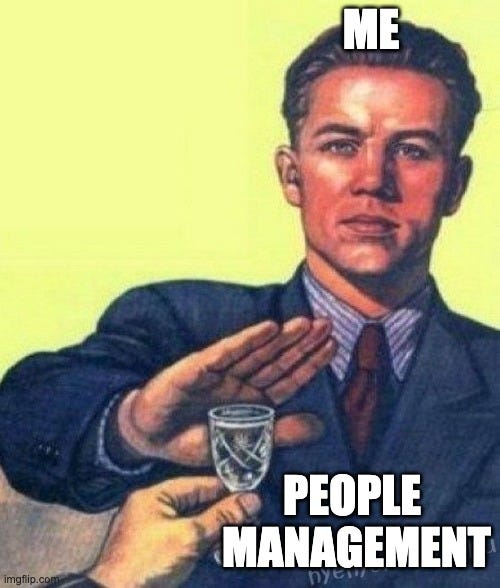
Conclusion: Why now?
Okay, so, what changed? Why are these new types of roles popping up?
I see a number of reasons:
(1) Companies are finally recognizing the problems of the old approach. The issue isn’t just that the system has been creating horrible managers. It’s even worse than that! There are so so many stories of an incredible IC who’s pushing the company forward in all the right ways, so they get promoted into management. It turns out they hate management—or just weren’t prepared for it—so they don’t do well at it. They become an underperforming employee and the company has to part ways with them. Talk about shooting yourself in the foot.
(2) Employees have a larger voice, now. As younger generations are entering the workforce, they’ve been better at articulating their needs. Millennials have done this better than GenXers, and Gen Z does it even more. Just recently, I’ve had multiple conversations with my team where people expressed their disinterest in managerial roles and their desire to pursue principal roles. I couldn’t be more proud of them for knowing what they want, and I support them to the moon and back.
(3) Improved collaboration tools and technology. There has been so much investment in project management and communications platforms over the last 10-15 years, which means less need for managers and more ability for strong ICs to manage themselves.
(4) The secret is out. With places like Linkedin and other public forums where people can share more details about their work life, more people are realizing… just how shitty most of the management jobs actually are. Insane stress, heart attacks, quality of life. People are starting to ask, “Wait, why would I want that?” These kinds of spaces show what has always been behind a curtain of sorts: the reality of life in management hasn’t always been readily available, so most people just saw the perks.
For all of these reasons and probably some more (AI, right?), we’re seeing a new range of possibilities for people to get many of the perks of leadership without forcing people into management.
Whatever path you take, I wish you all the best!
P.S. And don’t miss Leah Tharin’s post on this topic as well:

Edited with the help of Jonathan Yagel—check out his awesome Substack.
I think tha hardest part in learning to delegate is to lose the warm comfort of direct control everything.
AI is the key factor in this decision, not a small line without its own bullet 😜. It dramatically expands capabilities, making augmented senior ICs the new standard. AI accelerates career progression, enabling everyone to reach senior levels faster and seniors to advance to principal roles more quickly. This is mostly true today, and will be more solidified in the next 18-24 months.