

Lovable is one of the fastest growing companies of all time. Lovable turns two this week, and the numbers are unreal: Over $600 million in ARR, 1.2 million new projects created every week, and more than 1 billion monthly visits to apps built with Lovable.
So of course everyone wants to know how we did it.
I see so many people online trying to reverse engineer what we’re doing. Or they ask me: ‘What’s the biggest growth hack? How did you do it!?’
Well, first of all: It wasn’t me. I didn’t single-handedly create all this growth. Yeah, I’m responsible for growth at Lovable, but I was also responsible for growth at Dropbox, SurveyMonkey, and Amplitude. They did great but they didn’t grow like this.
But even more than that… Sad news, everybody: There’s no secret silver bullet. No ‘growth playbook’ is going to get you these results. Because Lovable-level results aren’t something that one person or even one function can deliver.
The way that Lovable has grown has been totally different from anything else I’ve ever experienced. So I’m proposing an extension on the legendary Racecar Growth Framework. I call it the Whitewater Framework: In fast-moving markets, the river creates the opportunity for extraordinary growth. Your job is to build a raft that can capture that growth, steer around the obstacles you can avoid, and survive the ones you can’t.
Sponsored by Chargebee: When we sell 100 AI credits, are we selling 100 units of value or 100 units of mystery? Too often, it’s the latter. And outcome-based pricing? Good luck finding a success metric customers agree on that also aligns with unpredictable LLM costs. So iterate we must. But iterating on AI pricing strategy is tough work. So do invest in flexible billing, metering, and monetization infrastructure. Chargebee delivers just that for fast-scaling businesses such as CodeRabbit, Zapier, HeyGen, and DeepL, among others. Check them out!
Sponsored by Apify: Apify is the largest marketplace of trusted, ready-to-run tools for AI. Find leads, track competitors, compare prices, and monitor social media. Feed fresh web data to your apps and AI agents. Start for free!

Find the fast-moving waters
Growth like Lovable becomes possible when you’re in an environment or market that is blowing up. James Currier described this as Finding the Fast Moving Water and that’s the mental model I’ve used ever since.
You can be smart, you can work hard, you can do lots of smart things, but I don’t think it’s possible to grow at this kind of rate unless you’re in a category that is growing super fast.
When I was at Miro, we were also in fast-moving waters during COVID. The whole world was working remotely and everyone needed virtual collaboration space. And then the pandemic ended and the river slowed down. When I was at Amplitude, it was a steady-moving river. Dropbox was more of a sea with a little current.
Well Lovable is navigating raging rapids. This is obvious to me because growth techniques that never worked for me before have started to work. The AI category is just expanding so fast that it’s carrying us along with it.
But… clearly not every AI company is successful. There are all these companies in these rapidly moving waters, but they’re not all catching the current. Or some of them caught it, but not in a good way.
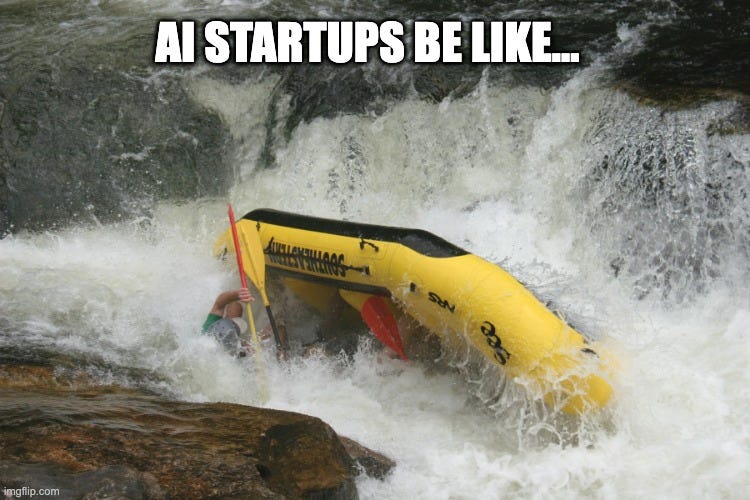
The river determines how fast you could grow. Your raft determines how much of that growth you actually capture. And just because the current is moving fast doesn’t mean everyone makes it downstream.
So what separates the companies that ride the current from those that get swept away? That’s where the Whitewater Framework comes in.
The whitewater framework
One of my all-time favorite models for growth is Lenny & Dan Hockenmaier’s Racecar Growth Framework. If you’re not familiar, the idea is that building a fast-growing company is like building a fast-driving car. Every part has a key job: the Growth Engine that drives the core loops, various forms of Fuel to keep the engine running, Lubricants to improve efficiency, and occasional Turbo Boosts to provide temporary acceleration.
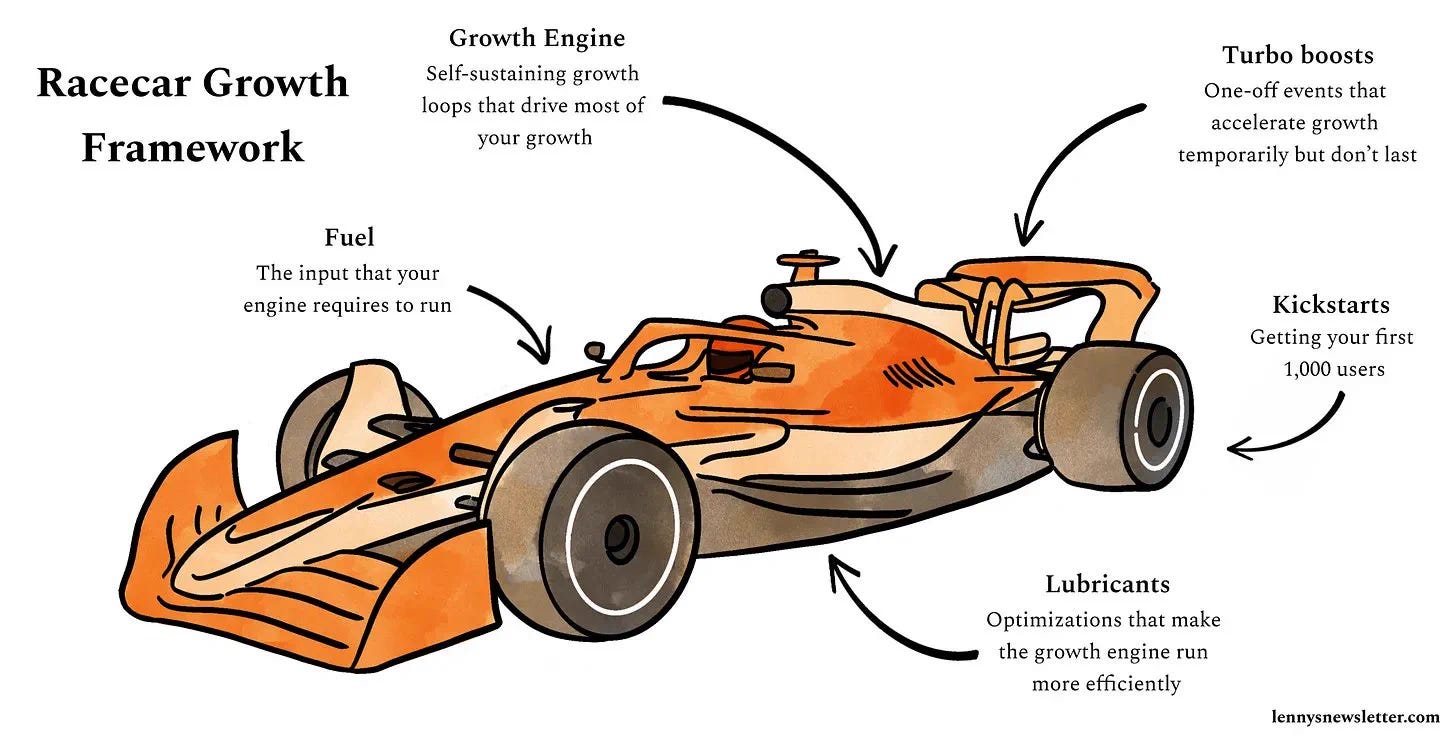
But as I’ve been living in the bizarro world of Lovable Growth for the last year, I’ve realized a different metaphor may be helpful. Because it hasn’t felt like we’ve been driving a finely tuned performance racing vehicle.
Growth in an AI-native org feels more like paddling a whitewater raft down a raging river.
The river is the engine
When you’re in fast moving water, the river is actually your engine. You’re not paddling for speed. You just need to survive. You’re avoiding the giant obstacles and bracing yourself because you are definitely going to hit some of those rocks really hard.
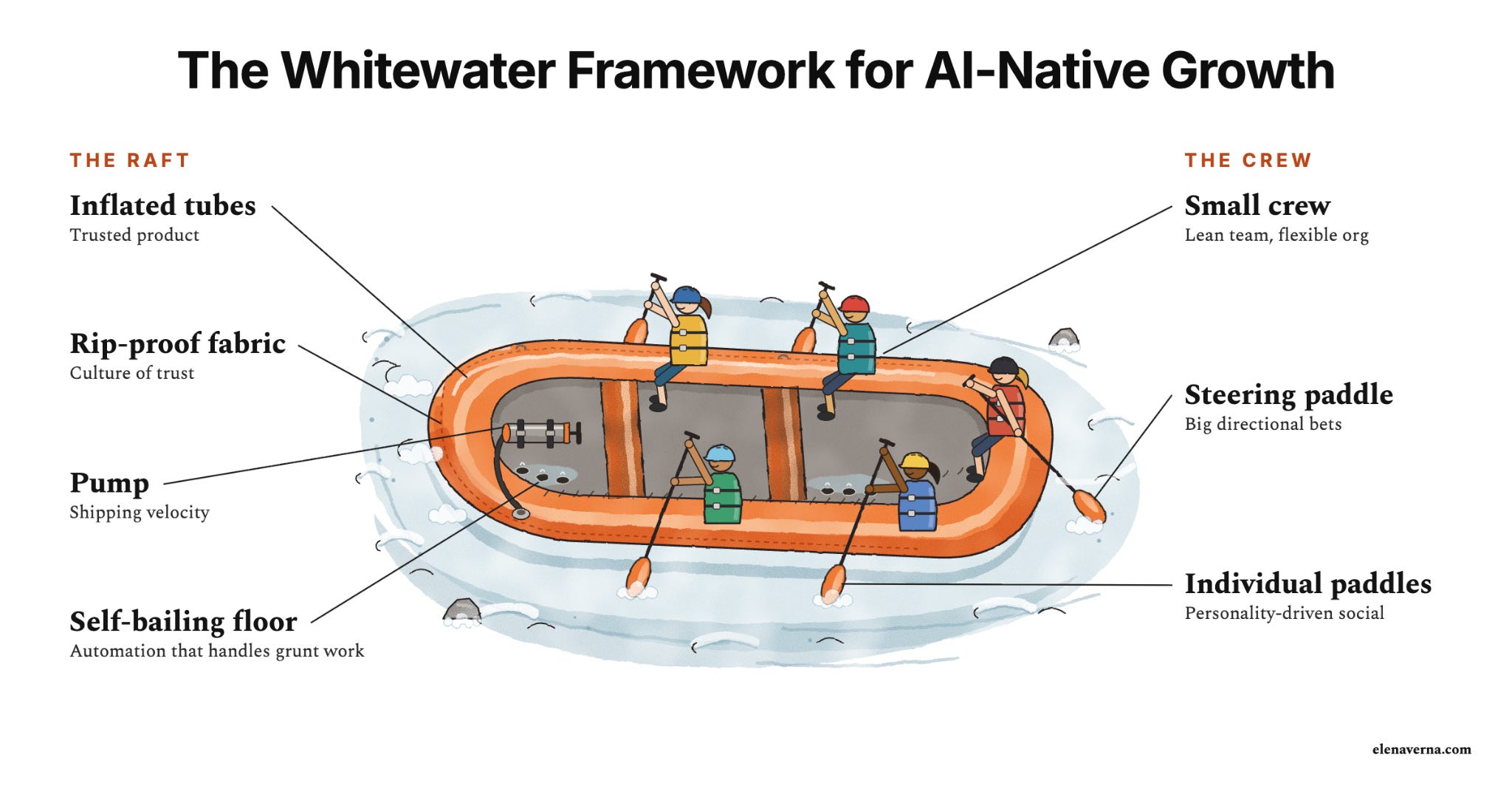
There are two parts. Building a raft that can survive in these conditions:
Inflated tubes: Amazing core product
Rip-proof fabric: Culture of trust
Pump: Shipping velocity
Self-bailing floor: AI automation that handles grunt work
And how the crew works:
Small crew: Lean, flexible org
Individual Paddles: Personality-driven social
Steering paddle: Big bets
1. Inflated tubes = An amazing product that people love
This is the one that makes everything else possible: you need a fucking amazing product that people will tell other people about. They have to love using it, understand how it works, and actually trust it enough to rely on it and tell other people about it.
Without this you sink, you’re dead, it’s over.
For AI-native companies, everything is happening so fast that you can’t always get marketing or comms or someone to present the product in the right way at the right time. The person is just going to hear about it online somewhere or (ideally) get it texted to them by a friend, and they’re just going to try it. So it all comes back to the product: Does it work? Is it good? Do people want to get onboard with you?
Obviously I didn’t create this product. I was given the gift of this lovable Lovable product to grow. And boy, has this gift just kept on giving. Because the degree of deep, constant care that goes into improving every element of the Lovable product experience makes bouncing along down the chaotic river of AI growth wayyyy easier.
2. Rip-proof fabric = Culture of trust
The first time you bonk up against a rock (and you will), think about what’s keeping everything together for your company. I truly hate to say it but… I’m pretty sure it’s your company culture.
The idea of ‘culture’ in most orgs makes me wanna throw up a little. It’s usually pure fluff, lip service you hear a lot about when a company is recruiting you or maybe there’s a long list of company values that no one can remember. ‘This team is a family’ blah blah blah.
But there’s one thing that is immediately obvious in any company you walk into: Do people here trust each other? Like, will people be totally honest about what’s wrong? Can we actually talk about why that thing didn’t work out, or do we need to do the I-don’t-want-to-get-blamed-for-this dance and have a retro that doesn’t actually lead to any changes?
This is maybe the most obvious with how a company treats its employees: Do people have the autonomy to make important decisions? Are you increasing what an IC can do on her own, or just pretty much screaming ‘We don’t trust you’ at them by way of your 15-step approval sequence?
I’ve seriously never seen a culture like Lovable’s: Autonomy and individual agency and people just going out and doing stuff. And clearly that didn’t happen by accident. This depends on a lot of decisions: the type of people that you hire, how you equip them, and the level of accountability and ownership you give them, to keep them energized. All that stuff is how you build a culture of trust.
Not easy to do and yeah once you tear that fabric, good luck repairing it. I don’t believe that you can revive a company where the culture has gone sour. Trust me, I’ve been there, seen that: people are resentful and irritable and mostly just roll their eyes whenever a new opportunity comes up. You can get as excited as you want, but you’re sinking whether you know it or not.
3. Pump = Shipping velocity
A raft is always losing air. Even without the collisions, it just sort of drains over time. Just like a product that has to improve all. the. time.
AI-native products have to constantly evolve in order for that word-of-mouth loop to keep growing. You can never stop launching. You have to constantly make noise in the market and constantly give people something to talk about.
Rapid, transparent updates build trust. It seems like we’ve got a massive update or announcement going out every week, so of course it’s not going to look like someone polished it for several months. Sometimes the “visuals” for major announcements are just screenshots or a selfie from the team.
While the Racecar approach has some limited Turbo Boosts to temporarily accelerate things, in AI world it feels like you have to keep adding these little bursts just to keep up. It’s so different from the cadence (and development lifecycle!) of a traditional software company.
We still have some big launch moments, which gives us an extra big burst of air. Whether it’s a product launch or a fundraise or a big new hire, there’s lots of material to keep pumping, but you have to realize that it’s part of the maintenance now, not just a rare thing. Always be launching!
4. Self-bailing floor = Automate with AI all the draining stuff
Okay, I didn’t actually know what this was called on a raft, lol. But these boats would get flooded pretty fast if they couldn’t drain water on their own.
And in fast-moving companies, if you can’t figure out how to reduce the repetitive grunt work, that’s all your team will ever do. You’ll be so busy keeping the existing business running that you’ll have no capacity to take advantage of the opportunities (currents!) flying past you.
At Lovable, people spend little time on things that could be automated with ai. In fact, when you join Lovable, one of the first things you’re expected to do is figure out which parts of your job are repetitive and predictable, and automate them away.
And this has fundamentally changed how I do growth. In my previous jobs, an enormous amount of my time went into optimization. Optimize this funnel, improve that conversion rate, fix this broken experience. And don’t get me wrong, that stuff is important! But what’s fascinating is that at Lovable, I’m doing dramatically less of it, yet it’s still happening. AI and automation are taking over more of the incremental improvements, and the responsibility for optimization is distributed across functions rather than sitting with a dedicated growth team.
Which means I get to spend a lot more of my time on the stuff that actually requires human creativity and judgment. Inventing new experiences, figuring out new growth loops, and taking bigger swings.
I think this is one of the biggest changes AI-native companies are bringing to growth. We’re moving from a world where humans spend most of their time maintaining and incrementally improving existing growth engines to one where machines can handle more of that work, freeing humans to invent the next ones.
Because when you’re navigating rapids, the last thing you want is your entire crew spending all their time bailing water out of the boat.

5. Small crew = Lean team, flexible org structure
Big company, big problems. The whole dance here is how to scale up while keeping things lean, but I do not envy the cruise ships carrying thousands or tens of thousands of employees through the rapids.
When things are moving fast, do you really want to have to keep a few dozen people in the loop just because someone was too lazy to take them off the RACI chart? If a new opportunity comes up and responsibilities change, a lean team can adjust on the fly without the existential panic that comes with large-co reorgs.

Okay okay Lovable is not exactly a nimble little kayak. Not anymore. But the team still operates like we’re small and scrappy and flexible. And the talent bar continues to be insane.
People here are all-in. They’re visibly passionate about the business, the customers, and the idea of making their work here the best work of their lives. When stuff gets gnarly, being surrounded by people who really care can keep you going. And by the way, reorgs here are happening often and are expected. Change is the only constant.
And hiring that kind of person is very hard to do.
6. Individual paddles = Personality-driven social
Now remember - the river is the growth engine here. But growth can be uneven, just like there are slow stretches between rapids, and that’s when you need your people to dig in and keep the momentum going.
And one of the biggest ways Lovable has done this is through social. But not the traditional corporate social media playbook where a marketing team painstakingly creates polished content for a company account that nobody actually follows.
B2B seems to be a couple decades behind our consumer tech counterparts when it comes to understanding how social works. People follow people. They want opinions, personalities, behind-the-scenes stories, and actual humans talking about things they care about. Not another beautifully designed carousel announcing a minor product update.
Lovable figured this out early. Instead of treating distribution as something that belongs exclusively to marketing, the company has made it something everyone can contribute to. Founders, employees, customers, partners. Everyone has a paddle, and everyone can help move the company forward.
What’s particularly interesting to me is how naturally this happens. At previous companies, my social presence was sometimes treated as a liability. Something that needed to be managed, approved, or carefully separated from the company. At Lovable, it’s an asset. People are encouraged to have their own voices, share what they’re working on, and build in public. And because there’s a culture of trust, you don’t need a communications department approving every single thing someone wants to say. (Although, to be fair, they’re not shy about giving me some VERY pointed feedback sometimes. Senka and Samyutha, I love you both :))
But the real magic is what happens when you extend this beyond employees. Your customers build something amazing, share it with their audience, and inspire more people to try the product. Those people build something of their own, share it, and the cycle continues. Partners create their own businesses on top of the product and have every incentive to spread the word. Distribution becomes a network of people who genuinely benefit from telling others about what they’re building.
And this is why having an amazing product matters so much. You can’t manufacture this kind of enthusiasm with an employee advocacy program and a few suggested LinkedIn posts. People have to actually want to talk about you.
The job then becomes less about controlling the message and more about giving people reasons to share.
7. Steering paddle = Big bets
Here’s the thing about navigating rapids: You can’t control the river. But you can decide which direction to steer. And those decisions can mean the difference between riding the current and crashing straight into a rock.
In a rapidly evolving category, nobody actually knows where the river is going. The technology is changing, customer behavior is changing, competitors are popping up everywhere, and what looked like an incredible opportunity three months ago might already be irrelevant. You’re making decisions with incomplete information, knowing full well that the conditions could change tomorrow.
But you still have to pick a direction. And more importantly, you have to get the entire company paddling toward it.
This is what I mean by big bets. Not another growth experiment or marketing campaign. I’m talking about company-wide commitments that require product, engineering, growth, and everyone else to align behind a shared conviction about where the market is heading.
And that’s a very different way of operating than what most companies are used to. Traditional strategy is often about creating a long-term roadmap, allocating resources, and then executing against that plan. But in fast-moving waters, your beautiful three-year strategy can become completely irrelevant before you’ve even finished your first quarter.
At Lovable, we’ve had to get comfortable making big directional bets without having all the answers. Sometimes that means investing heavily in something before we know exactly how it will monetize. Sometimes it means giving away a shocking amount of product to accelerate adoption. And sometimes it means changing priorities even when the thing we were working on was going perfectly well, simply because the opportunity somewhere else became so much bigger.
The hard part isn’t just having the courage to make those bets. It’s getting everyone to move together, quickly, without spending months building consensus. And it’s being willing to change direction when the river changes, without treating that as a failure of the original strategy.
Because that’s the paradox of growth in a rapidly evolving category: You need enormous conviction to get the entire company moving in one direction, and very little attachment to that direction when the conditions change.
Avoid some rocks, survive the rest.
So when people try to identify a few quick tactics and tricks that made Lovable grow like this, I have to laugh. It’s not some quick thing you can copy-paste into your org.
The best thing you can do is be honest with yourself about what kind of scenario you’re in:
Steady water: There’s two ways to look at this. On the one hand, you may be sitting in a stagnant, draining pond, where the only way forward is to make a desperate jump to a fast-moving alternative. But on the other hand: A more stable market is the only way you can actually build predictable growth. In either case, dig back into the Racecar fundamentals and figure out what it will actually take to grow.
Fast moving water: Build a ‘raft’ (product, culture, shipping cadence, systems) that can take a beating, and realize that traditional growth tactics aren’t going to be the main driver. Watch out for rocks and figure out how to get them out of your way, if you want to keep growing/surviving.
And founders/leaders, don’t try to poach someone from another AI company and expect them to magically fix your Growth trajectory. If your company is in a stagnant pond, bringing in a person who was just in the rapids isn’t going to change everything. They can’t create the current.
I realize this is a very different type of strategy than most organizations build, but that’s sort of the whole point. Knowing what kind of waters you are in gives you the best chance to succeed.
Edited by Jonathan Yagel.