

This post is brought to you by Sidebar - Sidebar is the leadership program where small peer groups grow and evolve together. Nothing will get you further in your career than learning from your peers.
It’s 2024, yet we live in a world that still confuses women's assertiveness with aggressiveness. A world where the words 'You're too aggressive' coupled with the seemingly innocent suggestion to 'smile more,' aren’t helpful advice—they’re a reflection of deeply rooted biases that feel diminishing, hurtful, and plain unfair. For countless women, myself included, such comments are not just an assessment of behavior but a stark reminder of the tightrope we walk daily.
Trying to be ambitious and assertive while also meeting old-school ideas of how women should act feels like an impossible act. Plus it hurts to think that the path to success is paved not with skill, but with compliance to outdated norms that equate femininity with being passive, nice, communal, and perpetually pleasant.
I got feedback of being too aggressive many times throughout my career. One of those times, I pushed back. I gave an example of my male colleague who was getting promotion after promotion, despite being an absolute dick. I was sternly told to not compare myself to others as everyone’s path is different. I needed to be nicer and prioritize the feelings of those around me to succeed… okay?
The irony is bitter.
In the pursuit of career advancement, women are often told that niceness is the key to unlocking opportunities, which couldn’t be farther from the truth. Because smile too much, and you will be questioned for not being serious enough. Be too nice and you’ll be labeled for not having enough drive. In reality, ‘niceness’ morphs into professional shackles that reinforce limiting perceptions of what a ‘successful’ woman should embody.
Assertiveness, on the other hand, is a trait celebrated and encouraged in the corporate world. Equated and correlated with success, even. But it’s a battleground for women. This distinction between assertiveness and aggression—a line so finely drawn yet so heavily policed—is at the core of this argument. Assertiveness, with its roots in confidence and clarity, is about standing firm in our convictions and advocating for ourselves and our teams with respect and purpose. Aggression, in contrast, is marked by a disregard for the perspectives and well-being of others. Despite these differences, the label of 'aggressive' is hastily applied to women who dare to speak with authority, challenge the norm, or simply stand up for what they believe.
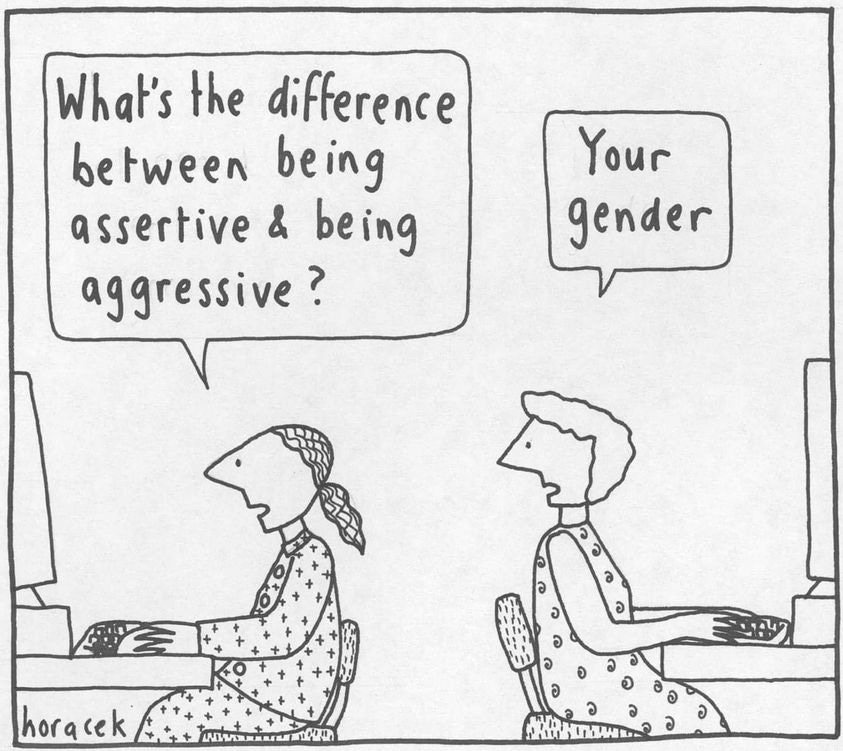
So remember, by labeling women ‘aggressive,’ you pressure us to fit a mold that is both uncomfortable and unrepresentative of our true potential: silencing our voices, diminishing our contributions, and stalling our career trajectories.
I still remember the last time somebody told me to smile more, as if it were yesterday. Seven years ago, my boss was about to go on stage for an all-hands presentation, with me sitting in the front row. He locked eyes with me and used his fingers to drag the corners of his mouth up, sending a clear message I should be smiling. In front of everyone. I felt humiliated, furious, and ashamed. I wish I had just walked out, but I didn’t. I put on a grin, while fuming on the inside. But I complied, which I hate to this day. Needless to say, I ended up leaving that job within months.
And don’t even get me started on motherhood, which traps us in a relentless tug-of-war: society insists moms have to dedicate their lives to children (or you are a bad mom, obviously), yet at our jobs, the work has to come first (or you are a bad employee, obviously). Leave the office early because the baby is sick one too many times and expect to start hearing feedback that we are not motivated enough, we don’t want it bad enough, we are not focused. But heaven forbid we choose not to have children—the whispers of future regret are deafening.
It's exhausting.
But ladies… There is a light at the end of the tunnel. Once you break through the VP ceiling, your so-called aggressiveness magically transforms into your highest praised quality: assertiveness. I’ve seen it first hand with my own career. Nobody has told me to be nicer or smile more since I’ve established myself as an exec. Maybe nobody dares to anymore.
Just as an example, here is an excerpt from my most recent leadership assessment:
Elena is rational, direct, and extraordinarily competitive. She zeroes in on and pursues opportunity without registering the emotional or procedural cost involved on the way to success. Elena’s leadership is rooted in a desire to make a profound impact; those who contribute will remain close to her and those who don't will realize she has moved on quietly without them.
This was a good, honest review of my capabilities. But earlier in my career, this same description would have been wielded against me as an indicator of aggressiveness.
The hardest part is to stay authentic and not conform to societal norms. As we embrace and accept who we are, we pave the way for a new definition of leadership—one that values diversity of thought, boldness, and integrity over niceness and superficial charm. The question is how to apply it in the most effective way within any given organization.
Never underestimate the power of a supportive manager, but I’ve also adapted to using ‘weak language’—and it works like magic :) Direct, assertive language worked well for my male counterparts but was met with resistance coming for me.
So, instead of saying: 'This is direction. Let's execute.'
I'd use a weak language and say: 'This might be a better direction, don't you think?'
This so-called weak language is an unappreciated source of strength. It got me to the desired business outcome faster, built stronger allies, and supercharged my career. So I adopted it as a norm. Most women in leadership have.
Adam Grant notes:
In one experiment, experienced managers watched videos of people negotiating for higher pay and weighed in on whether the request should be granted. The participants were more willing to support a salary bump for women — and said they would be more eager to work with them — if the request sounded tentative: “I don’t know how typical it is for people at my level to negotiate,” they said, following a script, “but I’m hopeful you’ll see my skill at negotiating as something important that I bring to the job.” By using a disclaimer (“I don’t know …”) and a hedge “(I hope …”), the women reinforced the supervisor’s authority and avoided the impression of arrogance.
The leadership journey is full of challenges for any woman.
But together our voices can shatter the glass ceilings built with outdated norms, paving the way for a future where success is defined by talent and tenacity, not by how much we smile.
I look forward to a future where being a strong, assertive woman is celebrated across all industries, job levels, and job types.
Edited with the help of Jonathan Yagel, check out his awesome Substack.
"Smile too much, and you will be questioned for not being serious enough" → this is spot on, and it's incredibly hard to maintain this balance. I meet a lot of potential clients / VCs / founders — 90% are male. That is already quite irritating, and the root cause is quite clear. You highlighted an interesting aspect of complexity with motherhood that I can only imagine for now, but another angle of complexity lies in combination with ageism (towards both sides — either looking too young and not representing the authority, or already too old to be competent in the fast-moving IT landscape).
We need to change the rules of this game.
It's so, so true. Can we all have an inner Elena please?