
Growth Is Now a Trust Problem
Growth is broken. Trust is the fix.

All of us are fighting a war on three fronts (thanks to AI). Customer product expectations are higher than ever. Distribution channels are collapsing. And everyone - big incumbents, new startups, even your own customers with vibecoding - are coming for your value prop.
How are you supposed to grow in this new landscape? It ain’t easy. But there’s a new playbook that I’m seeing emerge, and it’s all built around one simple concept: Trust.
Here’s how it changes how you should be thinking about your growth model.

This post is brought to you by Cello: Cello is the all-in-one Referral Platform for modern product-led businesses. It helps teams turn user referrals and affiliates into scalable, predictable growth channels - fully embedded into the product and on autopilot.
Trusted by companies like Miro, Descript, and VEED, Cello automates attribution, personal rewards, and optimization, so advocacy doesn’t stay a side project. Built for the AI era, Cello continuously learns to optimize for performance, helping teams drive an additional 15%+ annual revenue growth from referrals with no operational overhead.
Trust-based Acquisition
The classic distribution systems are falling apart. You may have been hearing this for a while - Andrew Chen pointed out that every marketing channel sucks right now, almost a year ago. But it’s getting worse. You’re probably starting to see all of your channels get to be more expensive or less efficient, or both. Unfortunately, I don’t see them getting better any time soon.
What’s Not Working Anymore
SEO and organic search. The obvious thing is that AI slop has reduced the barrier-to-entry for creating the content that SEO depends on. Now anyone can churn out dozens of articles with just a few prompts. But it’s deeper than that: SEO is all based on the assumption that people will primarily find information and access the Internet’s vast knowledge through Google searches that send them to web pages. That’s just not true anymore. People are going to ChatGPT, Claude, and Perplexity to get answers. And even when they do Google, the AI-generated answers intercept traffic before people ever click a link. And soon? People will use LLMs to navigate to products they already talked to AI about, the same way they use Google as a navigation bar now.
Want examples? Check out this post: AI is killing some companies, yet others are thriving - let’s look at the data
Paid search (SEM). This is the same thing as SEO, but the economics are more obvious: With the total number of searches not growing, the cost of placing your ads on those searches skyrockets as competition increases. Everyone’s bidding on the same keywords, and it’s getting harder and harder to maintain a positive ROAS. Plus, you’re not just competing with other companies but with AI tools that solve the same problem for $20/month. Good luck with that.
Corporate social. Social platforms are increasingly hostile toward corporate accounts and external links, optimizing for on-platform engagement. You might be able to get attention, but try to convert that into external traffic? No more juice for you. The algo giveth, the algo taketh away. Plus, the creative treadmill required to maintain polished ‘brand-aligned’ assets is expensive and exhausting. All for posts that still feel like interruption marketing. Which they are.
What’s Working Now
Employee-led social. When founders and employees share their thinking, their failures, their roadmap publicly, it demonstrates transparency and accountability. This isn’t about posting motivational LinkedIn content (please, make the carousel posts stop). It’s about sharing real expertise, examples, and demonstrating the humanity of your company. People buy from people they trust. Faces create that trust in ways corporate accounts never can.
Influencer and creator partnerships. When someone with an existing audience bets their reputation on recommending your product, it transfers trust. The key is finding partners whose audience genuinely matches your ICP and who will actually use and believe in what you’ve built. Not the ones who’ll promote anything for a check.
Community-driven growth. Your users become your distribution channel, but only if you build the infrastructure for it. Your product has to create stories worth sharing. But also give them a place to show their work, staff it so questions actually get answered, and let users teach each other - the best content explaining your product never comes from marketing. And when it works, community creates trust that marketing budgets can’t buy: users believe in your product because other people they respect believe in it. Features are easy to copy. Trust isn’t.
Want to boost your community with user referrals? Be sure to check out this post’s sponsor, Cello.
Product-led brand. Brand used to come from marketing campaigns and logo recognition. Now it comes from product experience. Brand is a product job, now. Every interaction, every feature, every detail either builds or reduces trust. The product itself has to demonstrate that you care about the user’s problem and will keep solving it better than anyone else.
You may have noticed that a lot of these channels feed into the same thing… building word of mouth. This isn’t a channel you can control really, but it’s the ultimate trust signal. If someone hears about your product from someone they know, that’s priceless. But it’s also super difficult to manufacture. It has to be woven into everything you are doing, how you are building, in your cultural values. And it’s not something you can do with a clever viral marketing campaign - that might get people to talk about your ads or your content, but if you want people discussing your product, you need to WOW them. And that comes from product, which is also your retention engine.
Trust-based Retention
Just like it’s killing traditional distribution channels on the one hand, the arrival of AI is ruining retention for traditional SaaS businesses. This is a little bit different from AI-native companies who are stuck on the PMF treadmill, but it’s the same idea - it’s all about your value prop.
At the end of the day, every company has to answer this critical question: ‘Why you? Why should users use (or keep using) your product? The answer always comes down to one of three options: You are…
Cheaper
More efficient (faster at solving the problem than alternatives)
More effective (able to produce a better outcome)
The problem for SaaS companies is that most of them were built around #1 or #2. In fact, out of all the growth workshops I’ve done with software companies, 9 out of 10 times, they say that ‘why’ is: ‘time to value vs. the manual approach.’
And now, that’s a major problem: AI is faster than any traditional tech hard-coded software product. It’s more efficient than your workflow tool. It answers questions better than your knowledge base. It generates content faster than your marketing platform. If your primary value proposition is efficiency or cost savings, you’re competing with something that will beat you on both dimensions AND costs your customers $20 per month.
Plus, even if your value prop does fall into the ‘More effective’ category, you’re at risk if that functionality is not utilized enough:
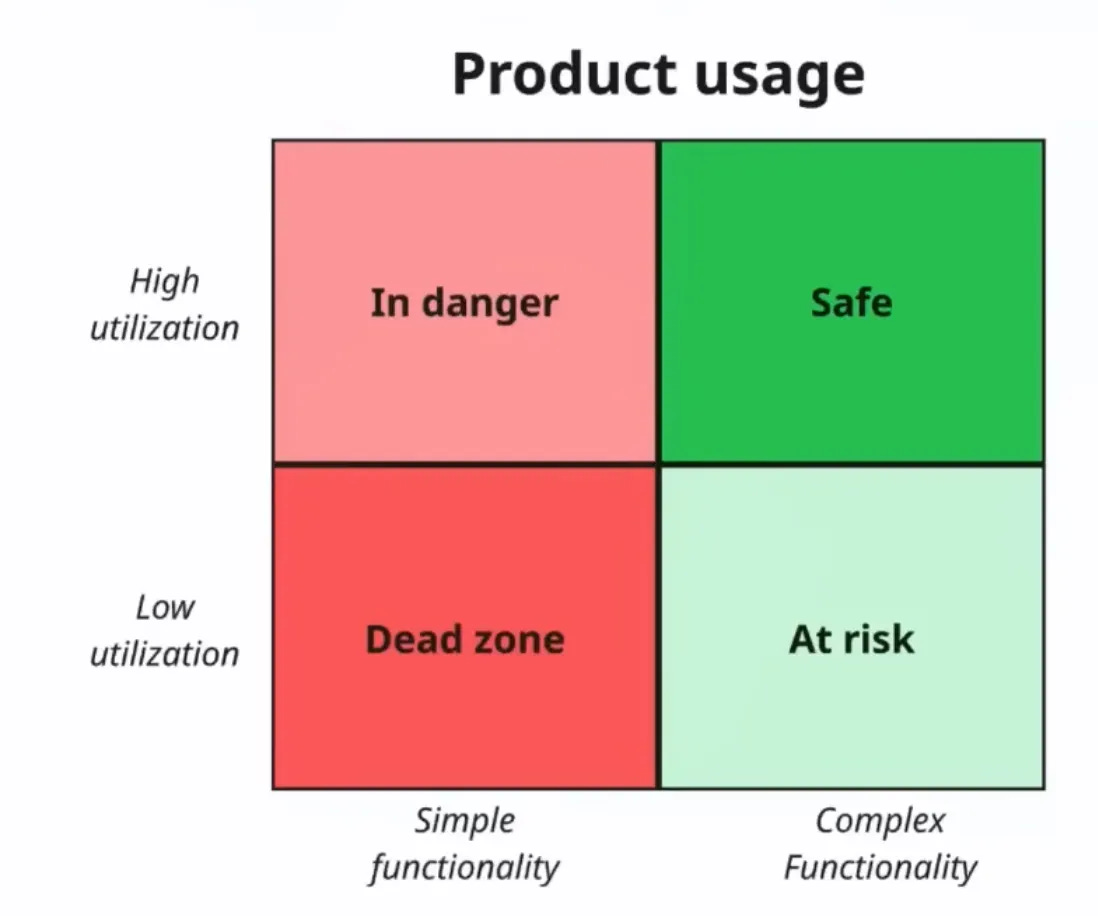
Add in the fact that AI can also be more effective because it’s better at understanding final intent…. and this means all of the traditional value props are weakened. So, utility-based value places you on shaky ground. When all the capabilities get commoditized, users will stick with the products they trust.
When all the capabilities get commoditized, users will stick with the products they trust.
More specifically, this kind of trust is confidence that this product and team will continue to deliver better outcomes over time. This depends on their belief that you genuinely care about their problem and will keep iterating to solve it better than anyone else.
Now, how do you build this kind of trust?
Transparent roadmap sharing. Not the sanitized public roadmap that commits to nothing. I mean real visibility into what you’re building and why. When customers see you’re thinking three steps ahead on their actual problems, it builds confidence that you’ll continue to be valuable even as AI capabilities expand. (And they will expand. Fast.)
Responsive iteration based on feedback. Speed matters, but it has to be in the right direction. Are you really listening to what customers need and building it? Or are you on a pre-made product roadmap that ignores their reality? The companies that tighten this feedback loop and ship legit improvements quickly are the ones that earn ongoing trust.
Amazing user experience / ‘WOW’ moments. I’m not talking about looking pretty. I mean showing through the product experience that you care about how people actually work. The delightful details, the thoughtful interactions, the features that anticipate needs - these ‘love marks’ in the product create an emotional connection that goes beyond the product’s utility.
Thoughtful lifecycle comms. Every email, update, and push notification is either building trust or reducing it. Are you creating value with your updates, or just bombarding people?
Monetization aligned with outcomes. Getting paid only when your customer succeeds is more than a pricing strategy. It’s a retention moat. It creates real trust, reduces churn, and removes the pressure on customers to justify their spend. It also avoids “sleeping bears” - customers who pay but don’t use the product, and wake up just in time to churn.
This is why brand is a product job now, not just a marketing job. The product itself must demonstrate trustworthiness. You can’t market your way into trust-based retention. Marketing can tell the story, but the product has to be the story. If those things don’t align, customers see right through it.
Trust is the Main Lever Behind Growth
Acquire through trust. Retain through trust. These aren’t separate strategies - they’re the same system playing out at different moments in the user journey.
Honestly, there aren’t that many products I actually trust. For me its Lovable, Miro, Whisperflow, Spotify, Granola, Oura, Stripe, Tesla, Netflix, Arc, Superhuman, Substack, ChatGPT among a few others. They’ve never let me down. I found each one through referrals. They continuously evolve and solve my problems. I enjoy using them. I’m rooting for them to succeed. Which ones do you trust? And why?

And what does this mean operationally?
Build this into your org structure & values. Product, marketing, and customer success can’t operate in silos. Trust-building requires everyone running in the same direction. Your founders and executives need to be visible in public channels and keep it real. Your product team needs to be talking directly to customers and shipping based on what they’re hearing. Fast. Your customer success team needs the access to influence product direction. If you still have org charts where these teams only talk in quarterly planning meetings, you’re already behind.
Optimize for velocity. Trust-based growth requires speed - both in how fast you ship and how fast you respond. Tighten the feedback loop between customer input and shipped features. Minimize cross-functional dependencies so teams can move without waiting for approval chains. Ship daily if you can. Micro-releases trigger something traditional marketing can’t: they make the product feel alive. Users signed up for version X… but they keep getting version X+!? This makes them feel like they got a free upgrade, and it builds trust and loyalty without you having to ask for it.
Learn to build in public. You’ve got to share your work as you go - a steady rhythm of progress, ideas, wins (and fails!), over time. The product becomes the story. The shipping cadence becomes the engagement strategy. And remember: this can’t be run by your corporate account. People don’t want the company POV. They want to hear from builders - your CEO, your engineers, your designers, the people who actually made the thing. That’s what makes it feel real instead of manufactured. It’s scary because you’re giving up control and polish. But when you’re moving fast, you don’t have time for Apple-style keynote presentations anyway. And honestly? Less polished is more effective. A super glossy ad is cool, but it elevates the brand… away from the people watching it. You want connection, not hype.
The companies that figure out trust-based growth will have a significant and lasting advantage. Trust is harder to build than features. It’s harder to replicate than efficiency. It compounds over time in ways that performance marketing never could.
AI will keep commoditizing product capabilities, which is why trust is becoming the moat that actually matters. The question isn’t whether to adopt this approach. The question is how quickly you can make the shift before your traditional channels and value propositions collapse completely.
And trust me: they’re collapsing faster than you think.
Edited by Jonathan Yagel.
Love this! I covered this topic ( from a different angle ) last week - check out my article - The Infrastructure of Belief 😍
Spot on RE paid search…categories have become a lot more crowded over the last decade and everyone is over-indexed on short-term campaigns like there is no tomorrow.
That means that everyone is targeting the same keywords, chasing the same signals, chasing the same audiences, which makes auctions and CPCs more expensive. We have seen this across the 50+ SaaS brand we work with.
That doesn’t mean paid search is dead, but it means trust is built before people go to search.
Content collabs, influencers, community, and employee led content are all focused on out-of-market buyers.
And the investments in building trust early make capture channels like search more efficient.