

(Disclosure: This post is part of a paid partnership with Typeform, including the use of the Research Flow platform at no cost. All of the findings and analysis are my own.)
IC work. So hot right now. I’ve seen it myself, going back to an IC role at Lovable. And a few months ago, I said that IC work is the new career flex and it ended up being my most-engaged post ever. So, seems like there’s something there.
So I decided to dig a bit deeper. I ran a study!
Some of my favorite highlights:
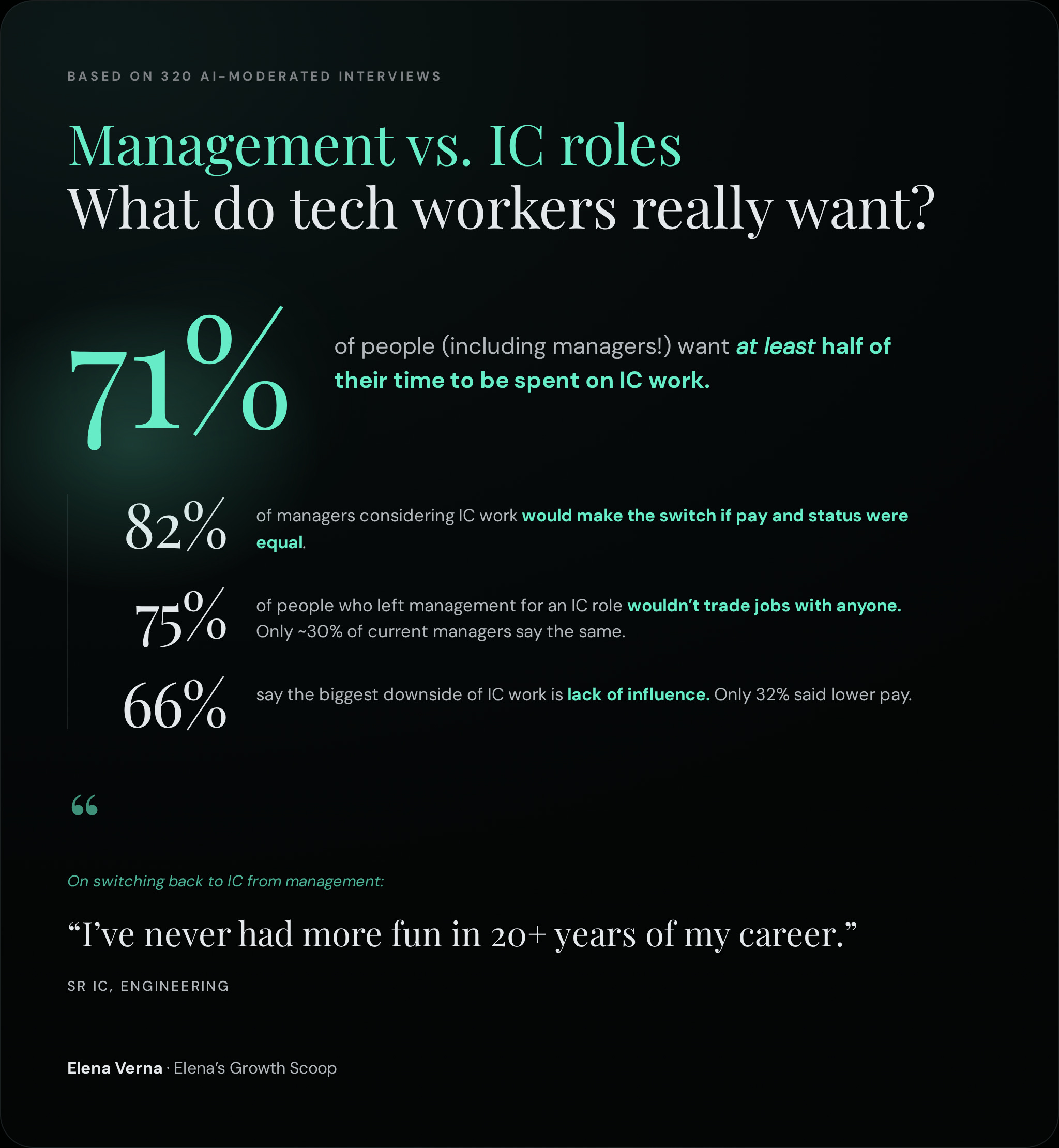
Yep, people want to do IC work: 71% of people (including managers!) want at least half of their time to be spent on IC work. 27% said they only want to do IC work.
Manager-turned-ICs wouldn’t trade it for anything: 75%+ of this group said they wouldn’t trade roles with anyone in the org. (vs. ~30% of current managers.)
The IC cost is… influence: Yep, 32% mentioned comp. But 66% of people said the main downside of being an IC is lack of influence.
But the numbers themselves weren’t the main thing. This was not just a quick-click survey. I teamed up with the Typeform team to try out their new Research Flow product to do a full-on panel of AI-moderated interviews.
We ended up getting 300+ people to talk through their career experience, their perspective, and what matters to them. And then used The Power of almighty AI to analyze and make sense of a huge amount of qual data, very quickly.
In this post, I’m going to focus on the experiences of a few particular groups of responses: people who have already made the jump from manager back to IC, plus those who are in management and considering making the swap. And then a group I didn’t really think about at first: the ‘player coaches’ who say they’re currently working as a manager AND as an IC.
Why did they do it? Do they regret it? What roles do they most envy in their orgs? Let’s find out.
Elena’s Picks
In every newsletter, I feature a few products and services that I personally recommend or am trying out. Let me know what you think:

→ Passionfroot Amplify: I’m a big fan (and investor)! They help connect companies with b2b creators, and they recently announced something new: while their platform is primarily a tool to connect companies with b2b creators, Passionfroot Amplify is a service where they run influencer campaigns beginning to end. They’ll help you figure out the story, find the right creators, and run the whole campaign.
👀 Check it out: Learn more. Can you find me on their landing page??
→ Research Flow by Typeform: The star of this very newsletter! I ran this entire study with the Research Flow product and got to work closely with the Typeform team to hear their vision for it. I’m excited for all teams (growth, marketing, product, everybody) to get to do way more high-quality qual research.
🎁 Offer: Schedule a demo and get $500 off. See terms and conditions.1
→ Lindy Teammate: I’m exploring this one because I still haven’t found AI agents that I love, and the Lindy team seems to be on the right track. They just launched this week, with the goal of a digital team member who can do stuff for your team right from Slack, using your company context (meetings, docs, etc etc). Things that marketing/growth teams hate: Tracking down data from obscure locations, building decks/dashboards, completing boring recurring tasks. So I’m hoping that Lindy Teammate will make these problems disappear.
🎁 Offer: 50% off for 3 months + 7-day trial. Use that link to get the discount!
There’s a lot here, so feel free to skip to the parts you find most interesting:
Part 1: Key findings
Part 2: Former-manager ICs are ‘getting their life back’
Part 3: Player Coaches love it or hate it.
Part 4: IC-leaning managers are trapped by golden handcuffs.
Part 5: How to build High-impact ICs (HI-Cs)
Part 1: Key Findings
What type of work do most people want to do? The assumption I’ve seen for my whole career is that people want to be managers and do management work. But if you strip out the perks of management, we found that this isn’t the case:
#1 - Most people want to do IC work - even managers.
Q8: If compensation, title, and prestige were identical, which role would you choose?
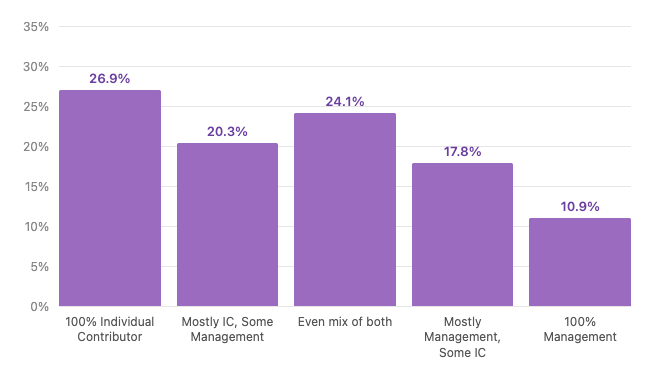
That’s right: The largest group (27%) want to stay 100% focused on IC work. 71% want at least half their time to be spent on IC tasks! Out of 320 respondents, only 35 want to do all management, all the time. (And of those 35: 31 are current managers or player-coaches! Only 4 ICs in the whole study would choose to do 100% management.)
The interest in IC work holds up even when we filter for those currently in management roles:
Q8: If compensation, title, and prestige were identical, which role would you choose?
(Filtered by ‘I’m currently a manager and want to stay in management’ and ‘I’m currently a manager and have considered returning to IC work.’)
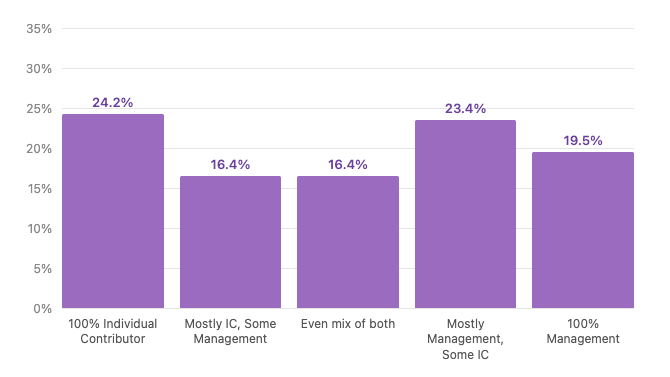
The largest group (24%) want to be 100% IC, and 57% want at least half of their time to be spent as an IC. Only 25 out of 128 managers would choose to do 100% management work.
#2 - Perks of management? Mentoring, Influence, Comp.
When we asked about the main benefits of management, the top answer was coaching and mentorship. But influence and comp were close behind.
Q9: What do you think is the main benefit of being in a management role? It’s okay if you have not been in this type of role, just share your beliefs. Select your top choice.
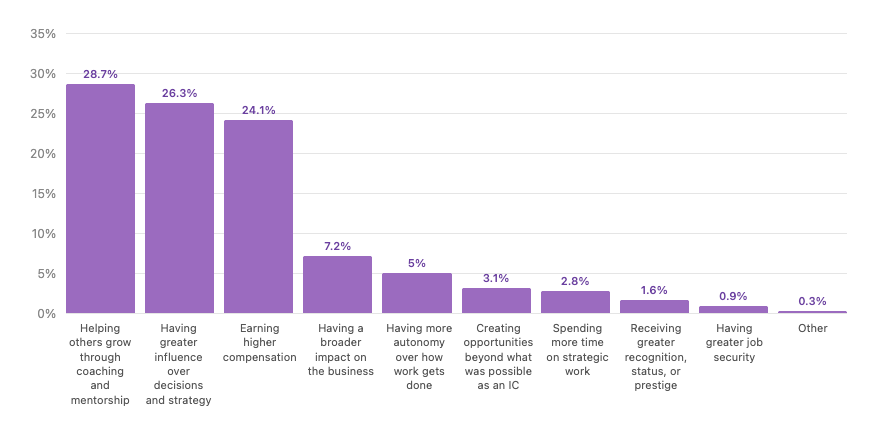
The top answer was growing others through coaching/mentorship (29%), closely followed by having greater influence over decisions/strategy (26%) and higher comp (24%).
#3 - Downsides of being a manager?
When asked about the downsides…
Q10: What do you think is the biggest downside of being in a management role? It’s okay if you have not been in this type of role, just share your beliefs about this type of role. Select your top choice.
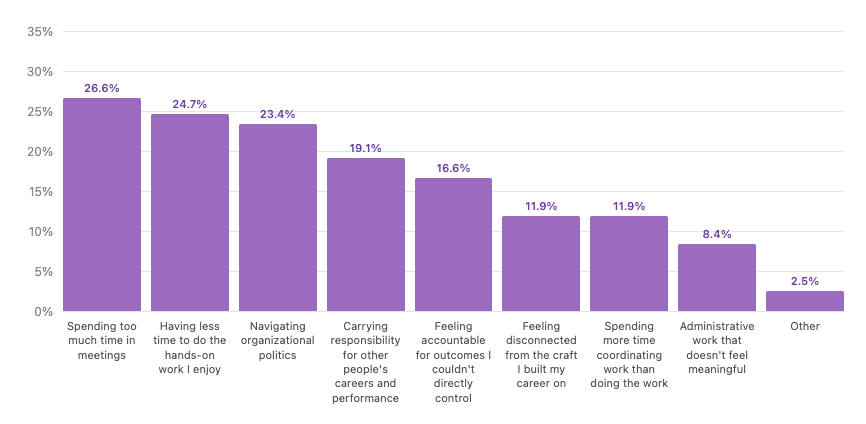
Just FYI: We allowed multiple-choice for the ‘downside’ questions - which is why you get more than 100%
Not too surprising: Mostly focused on too much time in meetings (27%), less time for hands-on work (25%), and navigating politics (23%). Responsibility for other people’s careers (19%) and outcomes (17%)
Managers also hated meetings (27%). But it was interesting that ICs with no management experience (both those who want to stay IC and those interested in management) significantly overestimated how much politics and loss of hands-on work would bother current managers. These ICs picked ‘navigating organizational politics’ at 32%, which was almost double what actual managers picked (16%).
This was even more dramatic for ‘less time for hands-on work’: this was the top perceived downside of management for ICs (39% of them selected this!), but only 19% of the actual managers mentioned this.
#4 - Upside of being an IC? More time to do hands-on work they enjoy.
People were surprisingly consistent with the main thing they liked about IC work:
Q11: What do you think is the main benefit of being an individual contributor (IC)? Select your top choice.
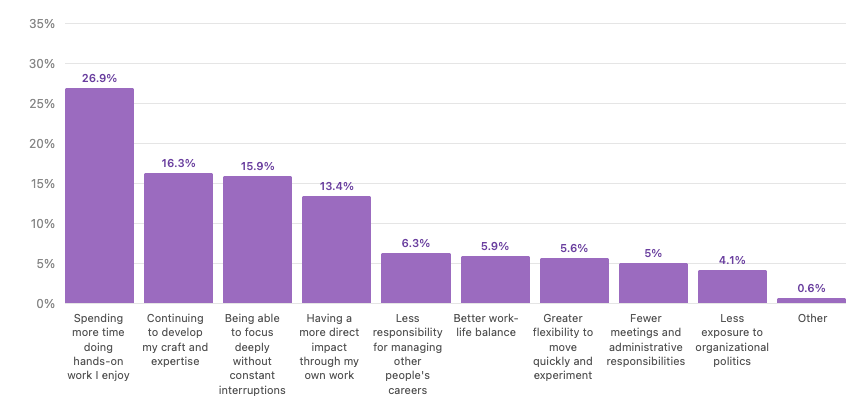
That was true across current managers, ICs, and player coaches. Although player coaches actually said that ‘Having a direct impact through my own work’ was almost as high! (23% vs. 24%)
#5 - Downside of being an IC? Influence > Money
When looking at the cost of staying IC, comp was the top response (32%). But… ‘Fewer opportunities to influence company strategy’ was close behind (30%)
And when you consider all of the closely-related responses, Influence is clearly the most common factor: ‘Fewer opportunities to influence company strategy’ + ‘Less influence over organizational decisions’ + ‘Less opportunity to shape the direction of a team or company’ + ‘Limited ownership outside my area of expertise’... altogether, you get 66% of respondents saying that organization influence is the main downside of staying IC!
Q12: What do you think are the biggest downsides of being an individual contributor (IC)? Select your top choice.
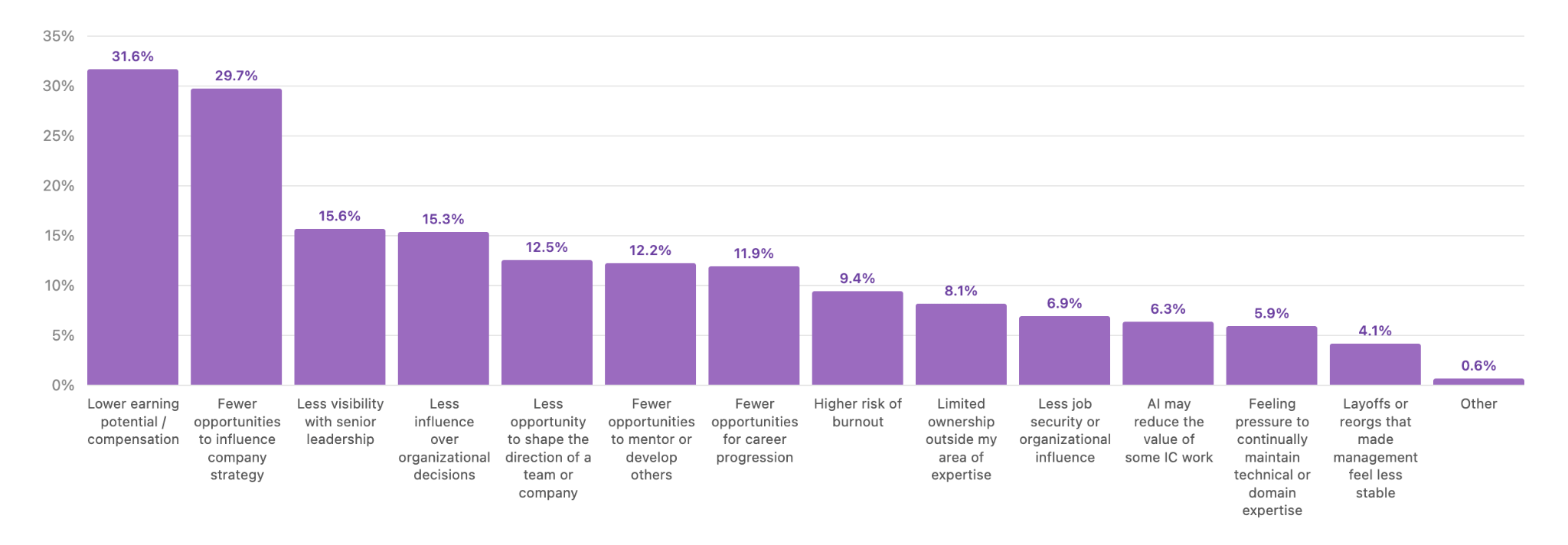
Managers were similar: 34% said comp was the biggest issue. 63% chose one of the influence-focused categories! And 31% of Player Coaches said comp, with 55% indicating some type of influence.
Want to run your own studies with Research Flow?
Schedule a demo with the Typeform crew.
Part 2: Former-manager ICs are ‘getting their life back’
This is the group I was most interested in. When I originally wrote that ‘IC work is the new career flex’ article, this is the group I was thinking about. So, it was cool to hear the real stories of 22 people who have gone through it.
‘I’ve never had more fun in 20+ years…’
One participant’s story really stood out to me:
‘About two years ago, I was laid off from a role as director of product and started a consulting firm, initially to offer product strategy consulting to early stage companies. In the summer of 2025, I did a lot of exploration with vibe coding tools and pivoted my business to focus more on helping early stage companies quickly validate their ideas with MVPs built via AI. That led to a consulting engagement helping an established company build a proof of concept, and then I came on full time, as an individual contributor vibe coder. I report to the CPO but my days are spent building and enhancing and stabilizing the application. And I’ve never had more fun in 20+ years of my career.’
Turning a layoff into a solopreneur strategy? I love it. Plus, jumping into vibecoding and using that to step into IC work is amazing. The study agent followed up to ask for more details: ‘What is it about doing the building yourself now that feels more fun than being a director?’
‘I think it’s a couple of things. One, first, as a director-level product leader, I had, you know, my days were mostly meetings. And I rarely had any time to feel like I actually delivered anything myself. Whereas in my current role, I am the cycle from ideation to definition to implementation takes you know, minutes to hours, maybe days. At the most. And I love the sense of actually building and delivering something of value multiple times a day.’
His comments about his quality of life sounded very very familiar:
‘So the interesting thing is I have more job satisfaction and less professional frustration than I’ve had in years of product leadership. So in that sense, it makes my work life balance and my quality of life much better. But on the flip side, I am having too much fun. I think it’s largely driven by my enjoyment, and I am working too much. Which pulls my quality of life holistically down a little bit. So from just a purely job satisfaction and satisfaction in general, I would say, uh, very much improved. From a work-life balance perspective, it’s slightly improved. I’m probably working longer hours, but the time that I’m not working, I’m happier, and I’m more present.’
When your main downside is that you’re having too much fun at work, so that it’s affecting your work-life balance, that’s usually a good thing.
Thoughts on ‘getting their life back’
That particular story wasn’t unique. Throughout almost every single one of the responses in this group, the managers who returned to IC work described a similar life upgrade:
Sr IC, Engineering (Berlin): ‘I noticed the level of energy. Before, I felt rather like a routine type of day. Now I sleep well. And I’m quite creative. I started a side project, open source, and interestingly I now have two investor calls next week.’
Sr IC, Design (Austria): ‘I’m in my forties. I have a family. I don’t need to put all of myself in my work.’
Director, HR (Bay Area): ‘I have more time to spend with my family. I have more time to focus on one or two projects and deliver quality and depth.’
Sr IC, Research (Michigan): ‘When my workday is done, my workday is done. I don’t need to be attentive to emails or DMs from my direct reports.’
I’m not saying that switching back to IC is all rainbows and unicorns. One former manager swapped to a senior product IC role because the pay was just too good, but ended up regretting it:
‘[It’s] a bit of buyer’s remorse. You know, look, the grass looks greener on the other side. As soon as I made the jump back into an IC role, the roles and responsibilities in the day to day, I miss being a manager.’
They envy… no one!?
The other thing that really surprised me about this group was their responses to the open ‘Whose role do you envy in the company’ question. Most of them said… nobody! Seriously. Check out their answers:
‘No. I don’t envy anyone else in the business. I really enjoy what I do, and I suppose I’m in a very fortunate position that I can span many areas of the business and get involved in any area.’
‘I don’t know that I really envy anyone’s role. [Before, in my previous role…] I was envious of teams that were able to ship faster than my team was able to, and I moved myself. To a position where I could ship more quickly. And so would say at the moment, I’m enjoying the things that I’m learning in my role and not particularly looking at another role with envy.’
‘Honestly, I don’t really envy any other roles. I really like my role. I like it the best of any role.’
‘Nobody. I think when I was managing people, I had team sizes of up to 20, 25. It was actually a role that I’m doing now that I envied. I envied people who could just kind of come in with their laptop, grab a desk, just get on with their day and not get disturbed. … But when you’re running a team, you really can’t do that. You have to be there and present. So, yeah, I did envy those people, but it’s something that I can do now, which is nice.’
‘I’m thinking about this. I’m not sure. Oh, okay. I think probably the people who do ops. No. Maybe maybe the program managers. No. I don’t know. I don’t know that there’s anyone whose job I really want. Happy in my job.’
‘No one. I think.’ [Follow-up: That’s interesting. What makes you feel that way—does your current role already have most of what you want?] ‘Exactly. My current role is the one that I would dream about.’
They just keep going. I was going to paste in all 16 of them, but I think you get the idea.
Out of the handful of people who chose another role in their company, one person said their CEO (he admired how much he could get done) and one said Director of Product (because the respondent had been demoted, and that was the role he would have had). Other than that, the only other responses that didn’t say ‘no one’ were just senior-level ICs in other functions.
Looking at the other job situations, this level of contentment in their role was definitely not normal. Analyzing the free-response questions is a bit tricky, but here’s a rough breakdown:
% of each group that responded to open-ended Q6: ‘Who at your company has the role you most envy?’ with ‘No one’ or ‘Nobody.’
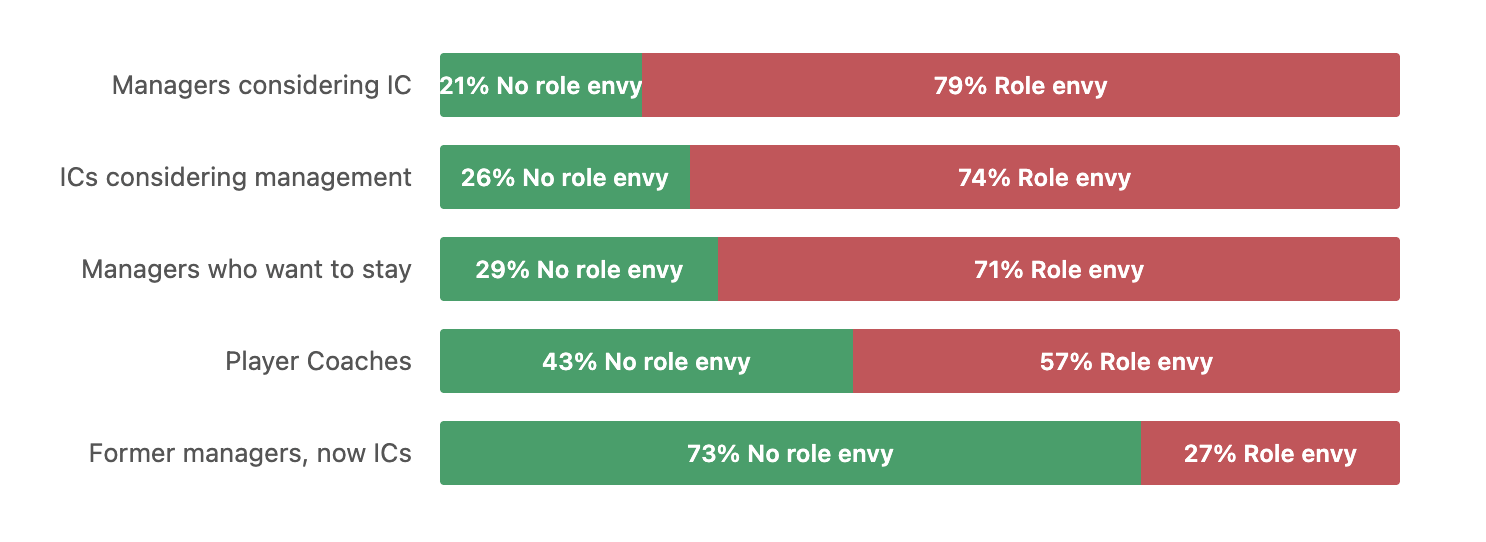
That’s right: Over 70% of all managers and ICs considering management had a specific role they envied. A bit over half of player coaches had a role they envied. And again, this is up against the former-managers-now-IC group, where only 1 in 4 were envious of someone else’s role! These people seem super content.
Part 3: Player Coaches love it or hate it.
The first big thing about this group is how many of them there are! 29% of all respondents fell into the ‘I’m currently doing both manager AND IC work’ category, which I call the player coaches.
The other thing that stood out to me is that this group was the most divided: On one hand, there are people who love the balance. But on the other hand, people who are forced into doing both are stretched thin and miserable.
Best of both worlds? If you choose it.
The Player Coaches overwhelmingly indicated that they wanted to stay in the 50/50 split between management and IC work:
Q8: If compensation, title, and prestige were identical, which role would you choose?
(Filtered by ‘I’m currently working as a manager AND as an individual contributor.’)
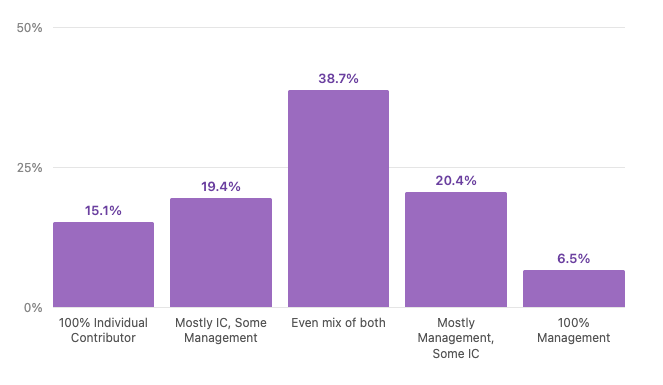
The majority of this group clearly wants to keep doing what they’re doing. And a lot of the comments from these Player Coaches mentioned how happy they are:
Head of Ops (California): ‘I find a lot of fulfillment in mentoring and helping grow and direct, unblock individuals. And then I also really need to solve problems and puzzles and figure things out and have novel work. I think just doing one of the tracts would be too boring, but by doing both, I get to contribute directly and help others succeed.’
Director, Marketing (London): ‘I get a lot of fulfillment in just seeing people in the team thrive. And knowing that I have a small part to play in their success. But I also need that time without constant interruptions to actually shape the strategy myself.’
Manager, Financial Services (Reading, UK): ‘I’m in two roles. I’m managing a team, plus I’m also working as an individual contributor. Which in itself is a very big high for me. There is no one else’s role I would like to take at this moment. I’m happy.’
Manager, Product (Vancouver): ‘I found a really nice niche role for myself because it is that blend of IC and management work in an area that is very exciting, but not under the executive super-pressure.’
Head of Marketing (Scandinavia): ‘I chose a hybrid role to stay close to floor work and keep up with what is happening. Having managed 12 direct reports before and now just 1, my quality of life is much better.’
Director, Community/Product (Kansas City): ‘I actually think I have the best job in the company. I’m not sure I would want somebody else’s job right now. I think a lot of people actually might want mine.’
Unfortunately, this wasn’t everyone. The biggest trend I saw is that people like this role… when they choose it. But a lot of the people who were forced into this role were miserable.
‘I literally have a pain in my neck because of the anxiety…’
One PM described his experience with this situation:
‘It’s a unique situation for the company. I used to manage people. With organizational changes, … the company doesn’t have an opportunity to open two roles. Because of the budget, they pay me once. And it worked fine. So it’s not really the same as say, Elena experienced, when she’s moved back to the IC role. … In my case, it’s because of the budget and because of the company’s weird structure.’
He said it’s been pretty brutal:
‘I’m working a lot, around, ten to twelve hours a day. Obviously, deprioritized some of the main functions of the day. So let’s say, I deprioritized sports, the way I eat, sometimes the way I sleep. So I always have been a workaholic, so I never have stuck to work-life balance. However, if I’m not trying to keep it in balance, like, it’s sort hard … Just super hard to stay sane. And most importantly, not only working a lot, but also, the constant stress. So, literally, I do have a real pain in my neck because I’m constantly having anxiety on the things that we should deliver.’
Being stretched too thin
This showed up in a lot of the stories:
Director, Design (Miami): ‘I find myself constantly trying to reach a state of coherence, not just for my team, but also for myself. I’m just mentally exhausted at the end of the day.’
Director, Marketing (London): ‘What I’m expected to deliver as a people leader and as a high-impact IC — that all works great. What has impacted my quality of life is the whiplash… coaching the team through reorgs while having less bandwidth.’
Head of Ops (California): ‘It’s hard to relay clarity, direction, and guidance when I don’t have it myself.’
Sr IC, Customer Success (Canada): ‘With my tier ones and twos always escalating to me, I don’t get a lot of uninterrupted time to just focus and try to solve problems. When I don’t get the things I enjoy doing at work, that makes me like my job a lot less.’
Head of Product (Belfast): ‘I do leave some time to spend with my toddler, but it’s back doing essential tasks late at night. Little time for gym, football, and other things I enjoy. [And it’s also hard] seeing the team implement features end to end and grow an area, while I am stuck in management meetings.’
Sr IC, Customer Success (Canada): ‘I envy the people who have already left [the company]. Because they were able to translate the work that we do here into less stressful positions.’
And one of the former-managers, a senior IC researcher from Canada, said it clearly, too: ‘Trying to do both is next to impossible. Management doesn’t scale proportionally.’
For a lot of these people, it seems like becoming a player coach is the result of an org that doesn’t have the discipline or clarity to give a particular lane. So they’re forced to do two jobs (or more) and expected to maintain what feels like an impossible standard of being excellent at both.
Part 4: IC-leaning managers are trapped by golden handcuffs.
When looking at the managers, I particularly wanted to dig into the group considering making this jump - managers who ‘have considered returning to IC work.‘
Managers considering IC are money motivated…
The most interesting stat to me: it seems 80%+ are stuck because of the money. Of the 51 managers who have considered going back to IC, 42 say they’d actually do it if money and status were equal. And 26 of those said 100% IC, another 16 said mostly IC. Only 2 out of the 51 leaned toward staying in management! Zero chose 100% management.
This isn’t that surprising, and the people in this situation seem to know what’s up: They listed the #1 benefit of management as comp (21 of 51 responses). And their most frequent pick for the biggest downside of IC was lower earning potential (20 of 51 included this in their multi-select).
… and miserable.
This group also reports worse quality of life: 47% said their current role leads to worse quality of life, vs. 39% saying better quality of life. This is much worse than the average across the whole group, where only 20% say their current role leads to worse quality of life, vs. 65% saying better. That means that this group of managers are more than twice as unhappy in their current roles, vs. the rest of the respondents.
For this group that’s considering moving to IC work, there are a few key themes:
Burnout and overwhelm - ‘I was so frustrated and so overwhelmed,’ ‘burnt out,’ ‘putting in a lot of hours… it just drained me completely,’ ‘eating into family time,’ managing 76 employees, working 10-hour days.
Loss of meaning - ‘I didn’t really feel a lot of fulfillment,’ ‘I don’t know what the impact is,’ the work feeling ‘stale,’ and feeling that they’ve drifted from the craft they loved.
People problems - difficult direct reports, having to cover for underperformers, a ‘nasty episode with a colleague,’ and having to fire people.
vs. happy managers, who tend to focus on mentorship.
Again: The group I described above are the ones who are looking at IC roles. The ‘I’m a manager and I want to stay a manager’ were (as you’d expect) a lot happier.
The managers who want to stay managers had a much better quality of life: 75% said work had a positive impact (vs. only 39% for the considering-IC group). And only 13% report that their role makes their life worse (vs. 47% for the other manager group). And their net score (+62pp) is actually similar to the former-managers-now-ICs (+59pp).
So, it seems like the people who genuinely want to manage and the people who left management are equally content. But the people stuck in the middle are suffering.
What’s the difference?
What separates the ‘stay’ managers from the ‘considering IC’ managers seems to be what they love, not what they hate. Both groups complain about the same things - too many meetings, accountability for things they can’t control, less hands-on work. The downsides are almost exactly the same, in rank order. The difference is on the benefits side:
The ‘want to stay’ group’s #1 benefit is coaching and mentorship (28 selections, vs. 13 from the considering-IC group).
The considering-IC group’s #1 benefit is compensation (21 vs. 15 for the stay group).
People who want to stay in management are happier in their roles and enjoy mentoring and coaching people (which was the top pick across all respondents), while the people looking for exits are unhappy and want to get out… but feel trapped. The thing keeping them there is the one remaining benefit - the money.
Part 5: How to build High-impact ICs (HI-Cs)
Going back to that one big stat: Most people would do IC work… IF comp and influence were equal. But that’s a big effing IF. That’s kind of the whole point - the gap in how ICs are paid and treated within the org is actually the main barrier.
Traditional IC roles are not going to make as much as company executives. That’s not realistic. But what is realistic is a career path that leads to what I’ve been calling High-impact IC (or HI-C) roles: A HI-C is an individual contributor who can complete a project that delivers business value, end-to-end, on their own.
Setting up this path is going to take effort on all sides.
Companies need to unlock the info flow.
For me, this was the single biggest concern about returning to IC work. After being at the executive level, I know that having the right context makes all the difference. I don’t necessarily need to be the one making decisions, but I absolutely cannot operate without knowing what’s really going on. Without the right info, I knew I’d inevitably get boxed into a corner, waste effort on unimportant stuff, and get pushed into less impactful work.
Unfortunately, most companies operate on some weird ‘Need to know’ basis, where even basic operational knowledge is kept hush-hush. If you want employees to deliver next-level impact… you gotta give them that next level of information.
(I wrote a whole different article about this, if you want to understand this part better: Your AI strategy has a trust problem, not a tooling problem.)
Employees need to step up and own impact.
I’m excited for organizations to start opening up these doors, but if you’re an employee looking for this kind of position, the ball is actually in your court.
The main thing that a HI-C does is deliver impact. Solve problems. Identify opportunities and own them. I totally get that the wrong org structure and bureaucratic BS policies can feel like they’re strangling you. But… they’re strangling your bosses, too.
If you’re waiting for someone to assign you this role, you’re already taking the wrong approach.
When you say you want autonomy (and so many people in this study did!), that also means you’re asking for responsibility: That was actually one of the things I insisted on, when swapping back to IC - the ability to make the calls for my projects. Because that’s one of the awesome/terrifying parts of being a leader: It’s up to you. A lot of Growth stuff is not kumbaya, everyone-agrees projects - there’s a lot of uncertainty and confusion, but someone still needs to make a decision.
The money will follow.
Maybe this is counterintuitive. Sure, lower earning power was a major concern in this study, but I actually think this is a lagging indicator. Traditional ICs don’t get paid well, because their impact is limited.
If an employee steps up to actually own a project that makes or saves the company a ton of money, it’s way easier to justify a larger comp plan for her.
Think of it like professional sports: Every player gets paid more than the coach! Yes, the coaches still make millions per year to make sure that the team works together and all achieves their potential. But each individual on the team gets compensated based on their individual talent.
Sure, there are different types of downsides that come with that, but if elite performers on the fields and courts around the world can get paid more than their managers, maybe us keyboard-jockeys can do the same thing.
Thanks to this study, we know that a large majority of people in tech would choose IC work if the pay was equal.
What would happen if we start paying ICs more than managers? That’ll be the true test of when AI has completely changed the way we work.
Thanks to the Typeform team for making this possible!
Fun story: When they first reached out to me to do a paid sponsorship and set up a study, I didn’t get it.
I’ve been a Typeform user for a long time, so I figured it was, I guess, some AI analysis on top of a large-scale survey?
But as you could probably tell: This was a lot more like a major research panel, with people chatting about their experiences and perspective, out loud.
Except I could essentially run the whole thing on my own. The future of research is gonna be awesome.
Want to try out Research Flow?
You can set up a call with the nice folks at Typeform, right here:
Thanks to Jonathan Yagel for editing this post, and also helping to build and review the study!
Appendix - Who are all these people?
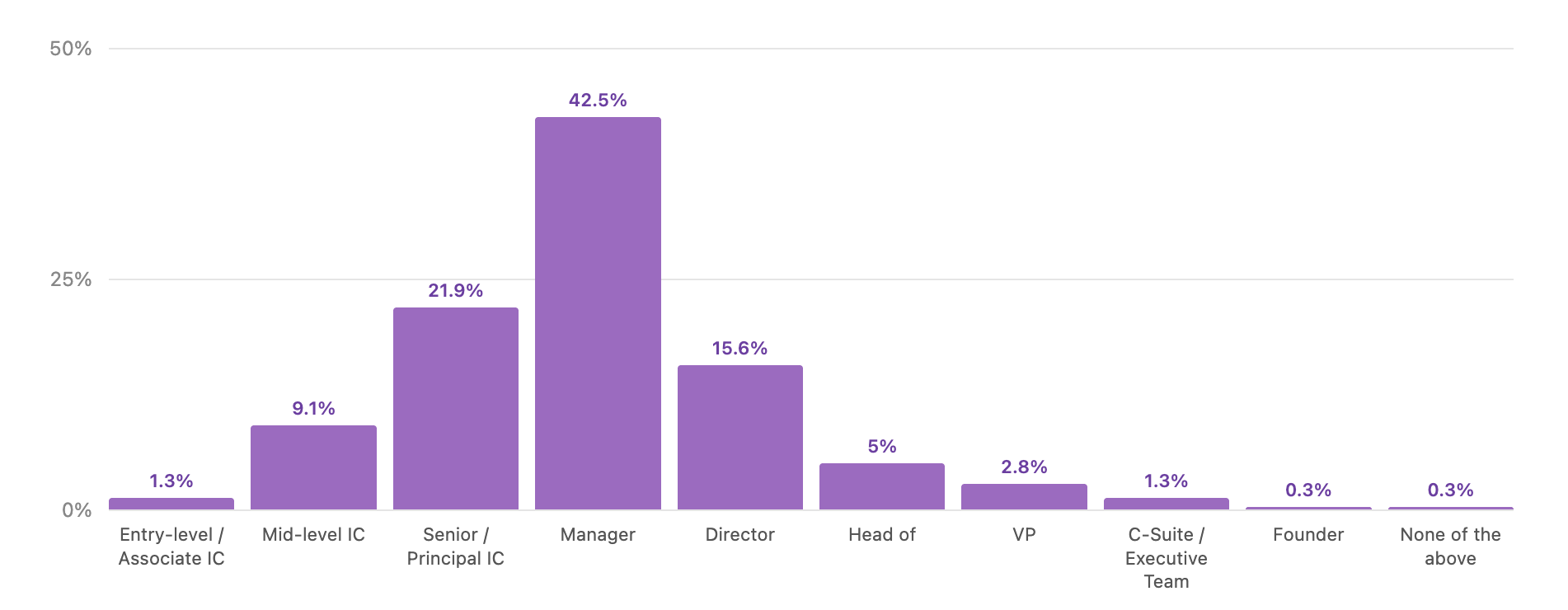
Title: Mostly managers, but pretty evenly split.
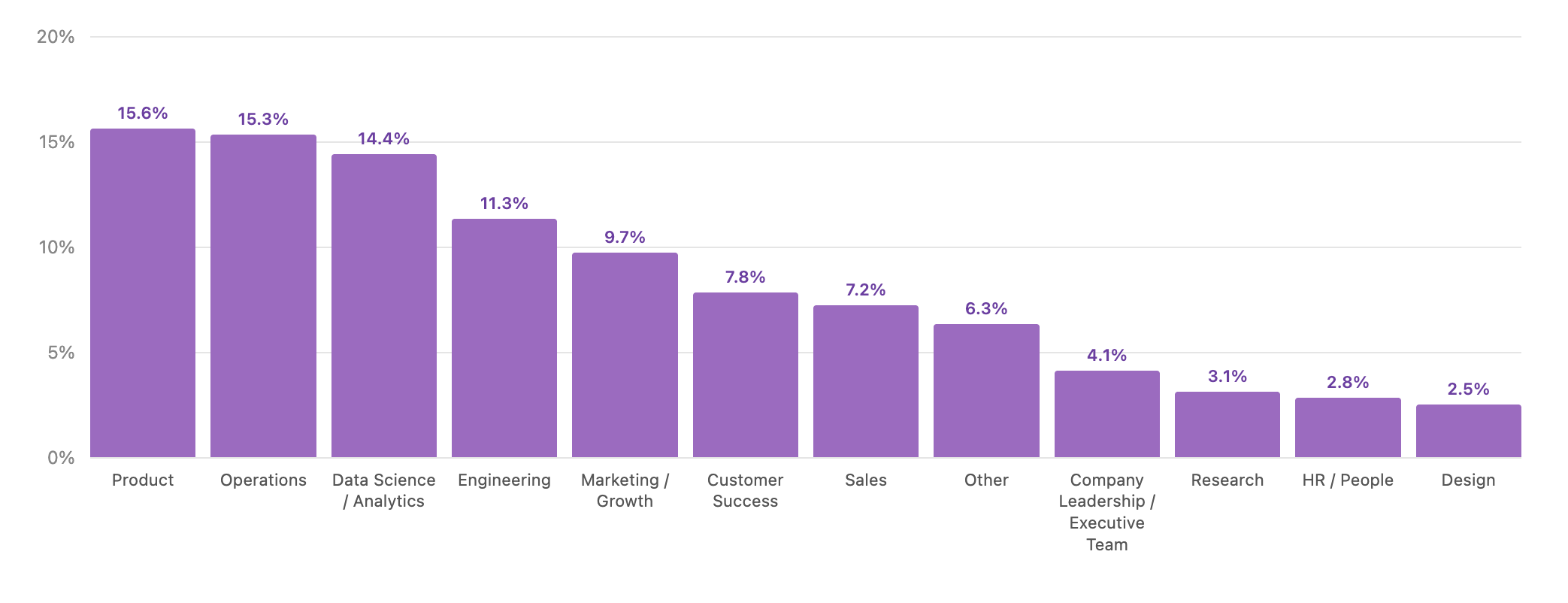
Functions: A wide variety, but mostly Product, Ops, and Data
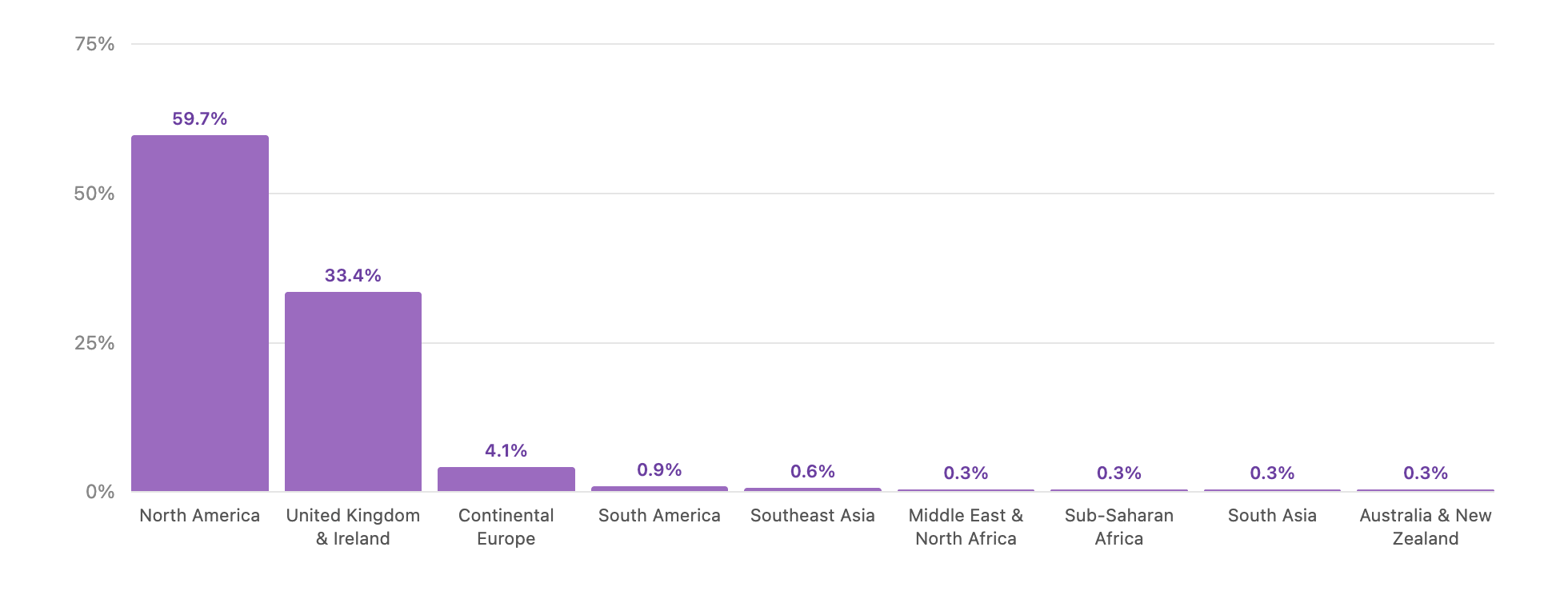
Locations: Mostly from the US (60%) and UK/Ireland (30%).
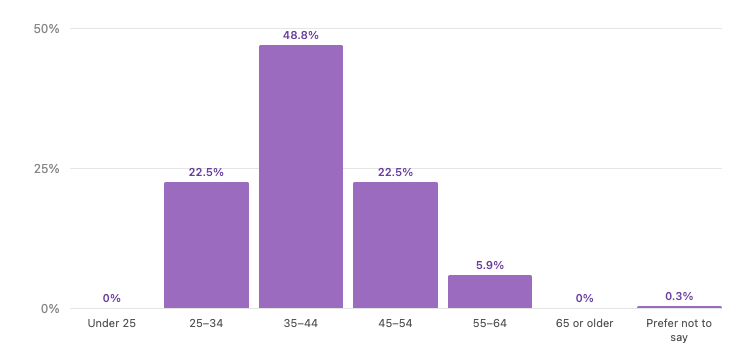
Age: Mostly 35-44 (49%) with most of the rest being evenly split between 25-34 and 45-54 (23% each)
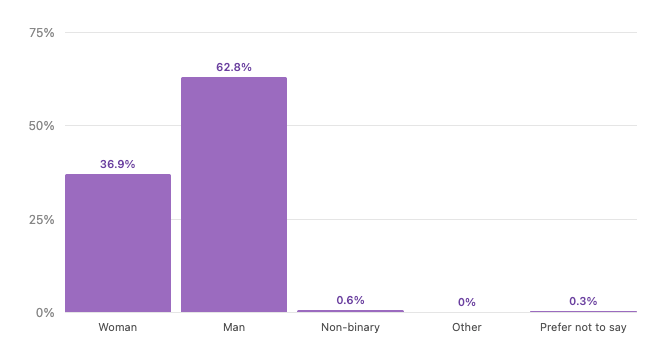
Gender: More men (63%) than women (37%)
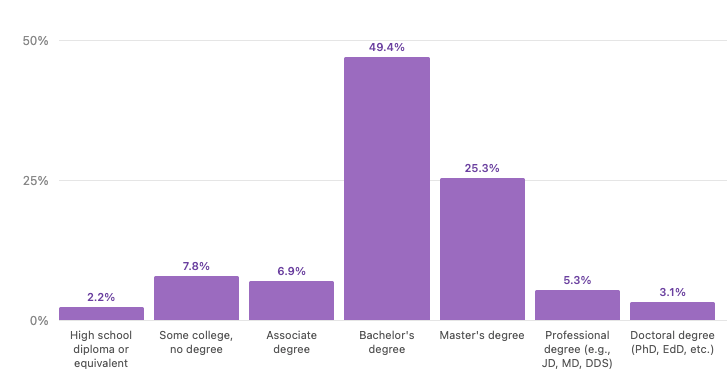
Education: Mostly Bachelor’s degrees (49%), then Master’s (25%)
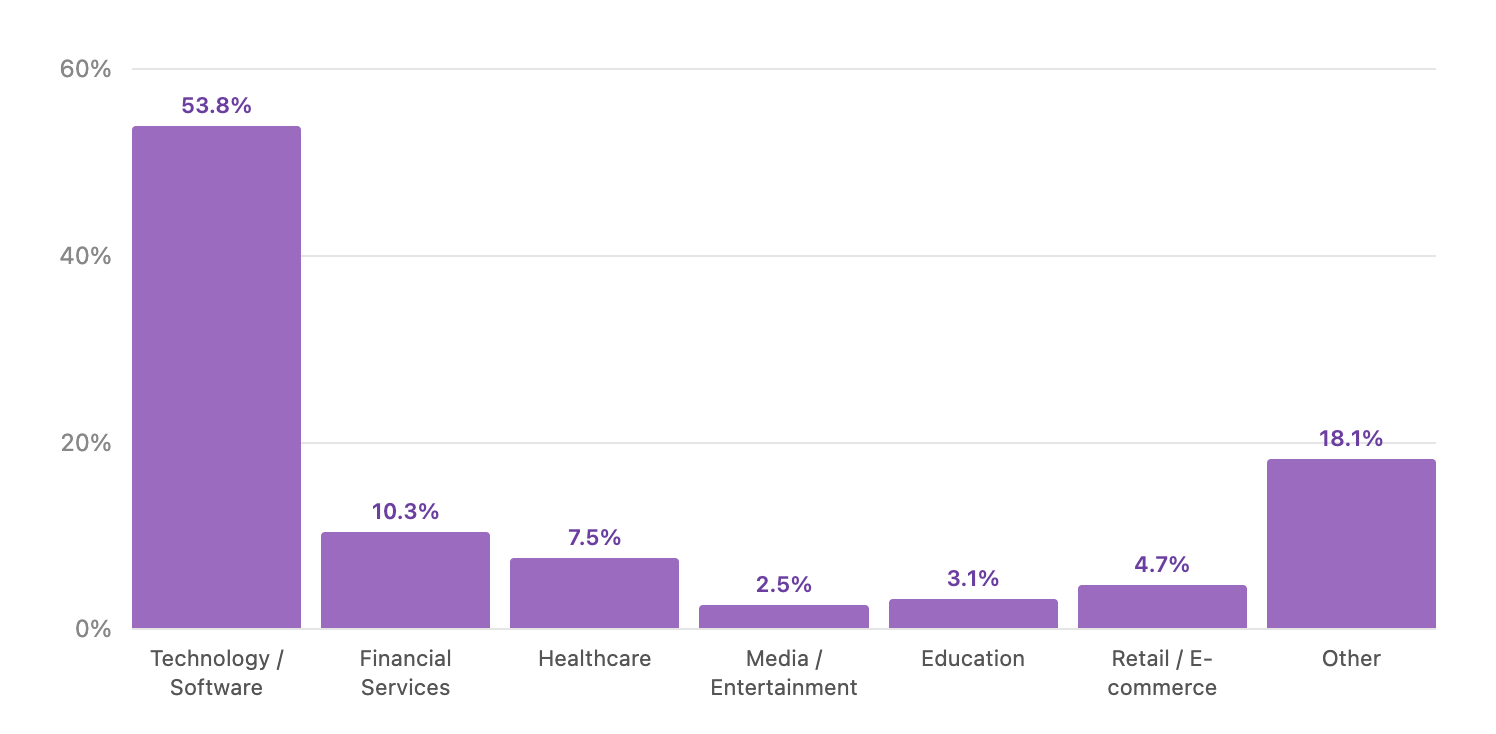
Industry: About half (54%) directly in the tech/software industry, with tech-focused workers in other industries making up the other half.
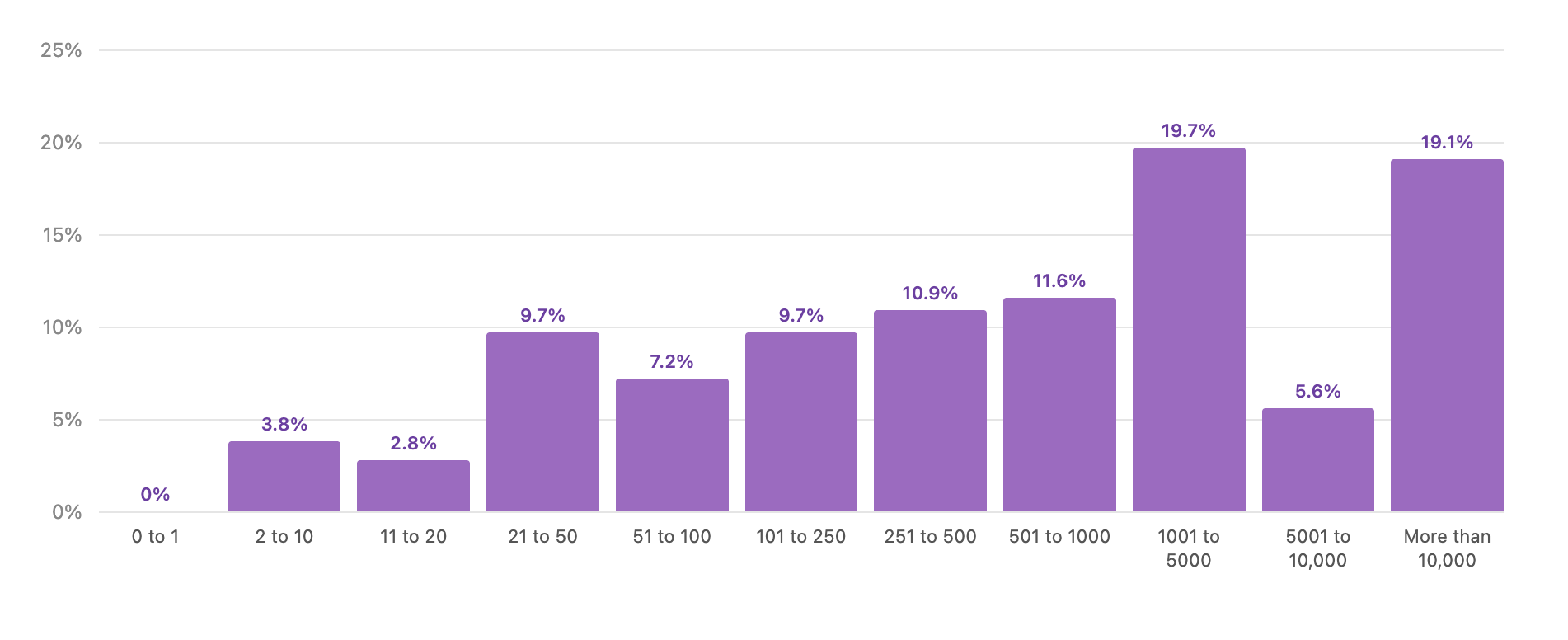
Org size: Evenly distributed across org sizes, but ~55% ≤1k employees, 45% ≥1k employees.
Title:
Functions:
Location:
Age:
Gender:
Education:
Industry:
Org Size:
* Terms for $500 discount on Research Flow:
Valid until September 30, 2026. New Research Flow customers only. $500 off the first annual subscription, applied after eligibility is confirmed. One per customer/account. Not combinable with other offers; no cash value; non-transferable. Subject to a signed order form and Typeform's applicable subscription terms. Typeform may change or withdraw this offer at any time. Data handled per our Privacy Policy.
Thanks
This tracks with what I see on the India side, and there is a pay reason under the preference. Manager titles used to be the raise. Now a lot of first-time managers get the CTC but lose the craft, and about 60% struggle out of the role within two years (Acumen 2026). Meanwhile the money moved to specialist IC lanes: AI-adjacent, decision-heavy roles are seeing 18 to 35% hikes while the average sits near 9% (Deloitte, Aon 2026). So people don't just want IC work, the market is starting to pay for it. Is the manager-turned-IC flex real, or only affordable for people who already banked the title first?
Zia. itszia.ai