

Edit: The original title of this post was ‘You’ll lose your job in 2027.’ I changed the headline.
A few readers shared that the original title felt painful in the context of recent layoffs. After reflecting on that feedback, I agreed the framing missed the mark. I’m sorry.
I still stand by the core message: our jobs are changing rapidly, and the point of this post was to encourage people to proactively adapt before change is forced upon them.
For anyone working in tech, I’m sorry to say this, but there’s a real chance you will not have the same job by the end of 2027.
Some of that will be because of layoffs. Intuit and Meta just announced cuts, and I don’t think anyone seriously believes we’re done seeing more.
But even if you keep your seat, your actual job is going to change. A lot. The responsibilities, expectations, tools, scope of what you’re capable of accomplishing, bar for what ‘good’ looks like, and number of people needed to do the work are all being rewritten every day.
It’s already happening to me. I know it will affect you too. In some cases, I fired myself out of parts of my own role. In other cases, I got fired out of responsibilities by the pace of the company, the shape of the org, and the reality of AI. Things I used to own either became less relevant, moved to someone else, got automated, or needed a totally different operating model.
So yes, I technically stayed at the same company. But I do not have the same job. And more likely than not, neither will you.
Change is coming. Which is great news.
Sponsored by Optimizely: Join the FREE 2-hour virtual event on June 17 for digital leaders. Discover how to run more experiments with AI, hear from Elena Verna (me!), see 5 agent demos end-to-end, learn how Salesforce, BBC & ASOS scale testing, plus exclusive content. → Save your spot
Sponsored by Amplitude: build better products with our AI analytics platform. With powerful AI Agents embedded across our platform, teams can analyze, test, and optimize user experiences faster than ever. → Learn more

Wait, great news?? Yes. Because right now, it’s not too late. You can start rebuilding yourself before someone else decides what version of your job survives. Imagine yourself like Scrooge waking up on Christmas morning, with a new lease on life.

You still have your job! You still have time to make changes! But… it is time to start preparing for those changes.
You get to decide what to do about it.
The first step is to be honest with yourself about this reality. Yes, it’s uncomfortable. Yes, it’s scary. But the only thing worse is pretending that it’s not happening. (see: Get your head out of the sand.)
But you better not stop there. Here’s what I would put on my ‘Prepare for a Job Change in 2027’ action list:
Step 1: Ask yourself: do you actually like your job?
This is uncomfortable, especially if you’ve been in it for a while. But as things keep changing, the competition is going to get more intense. You’re not going to win out in the same role over someone who loves what they do.
And if there are going to be dramatic changes in your role, maybe this is a chance to finally pivot into something you do get excited about. Maybe that’s a more niche speciality. Maybe it’s switching industries. Maybe that’s going back to IC work (see: IC work is the new career flex - which is what I did).
Step 2: Start exploring career optionality.
I’ve been beating this drum for years. If you’re ever going to do it… now is an ideal time to get started.
If you’ve been telling yourself, ‘I’m too risk averse to go out on my own. I need the stability of a full-time gig.’ Well, I’ve got good news and bad news for you.

Your current path is no longer a safe, stable option.
Even before all of this rapid AI transformation, the stability of full-time work has been pretty sus: If you’re junior, you’re the closest to being replaced. If you’re senior, you’re an expensive line item.
Think of all your friends and colleagues who have lost their jobs despite being awesome at what they do, and you have to acknowledge that expecting your career to last indefinitely is just staying on the Titanic while the lifeboats float away.
So get started right now. Like, today. Because the good and bad news is… solopreneurship doesn’t happen overnight. I wouldn’t recommend that anyone should leave their job with no momentum or progress. It usually takes a while to figure out what you want to do and what the market will pay for, so start that process right now.
Then, by the time you’re ready for a change - whether that’s because your job changes or you’ve got enough progress that you’re ready to go all-in - you’ll have the foundation in place.
And guess what, you’ve already got a great headstart. Just think of your career options as a product you are working on…
Optionality 1: Your skill IS the product.
I went down this road, and I’ve seen many other people go this way too. This path usually leads to a services business: consulting, advising, freelancing, or some other version of trading your time for money outside a full-time employment model.
I started investing in this path about five years ago. Today, I make more from solopreneurship than I do from the cash comp of my full-time role. To get started, think of your brain as a product you need to build a company/growth around:
Acquisition: Where can you find new clients? Tell your network that you’re looking for 1-2 clients. Share your unique POV on LinkedIn or Substack and chat with people who seem interested. Counter-pitch those recruiters in your DMs! Post your Claude Skills (and Lovable skills, obvi) to show off your expertise.
Activation & Retention: What’s the ‘Ah ha!’ moment you can deliver to your customer? What is your unique value proposition? Is it one-off or ongoing?
Monetization: Charging an hourly rate is a good place to get started, but monthly retainers are better to protect your time.
I wrote a deep dive on this approach, here: Is solopreneurship right for you?
Optionality #2: Get yourself a Mom ‘n’ Pop SaaS.
It’s become insanely easy to actually build software products - are you taking advantage? You can take your specific expertise, package it into software for a niche audience, and sell it as a one-off purchase or a monthly/annual subscription?
I call this ‘Mom ’n’ Pop SaaS.’ Not every software business needs to become a venture-backed unicorn cosplay exercise. The goal can be much simpler: keep it small, useful, profitable, and yours. Maybe it only makes $3k/month. But $3k/month in semi-passive income is ahmazing. With the cost of development disappearing, this now has very positive ROI.
And lack of technical background is no longer your blocker - AI tools help you build the actual thing. Cough… give Lovable a try, cough.
Which brings me to the next must-have…
Step 3: Become AI native.
Most people hear the term ‘AI-native’ and either start cheering loudly or throwing up in their mouth a little bit. The reactions are extreme. But one thing is clear: getting good at this will help you keep your job, reshape your job, or find your next one.
Just please get going right now. And don’t overwhelm yourself - start small. The point is that AI-native is not about having an LLM open in your browser all the time. It’s about how you think about the value of your work and how you approach it.
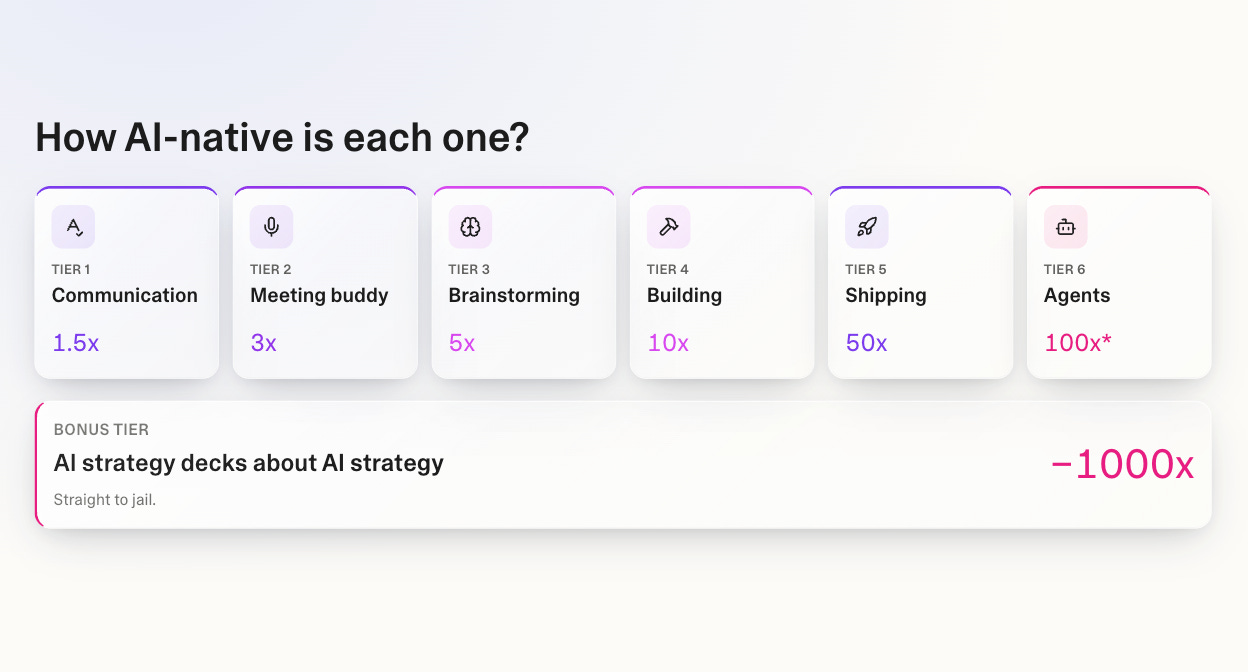
At this point, I see AI-native-ness as a series of tiers, in terms of how you’re actually using LLMs:
Tier 1: Writing buddy
This is a great place to start. All of us write stuff… so use AI to improve the clarity of your written communication, because good communication is still somehow one of the most rare corporate superpowers. Pro-tip: Write your own version and then have AI critique it, so you actually learn. Don’t be sloppy!
Prompt examples:
“Make this more clear”
“Help me make my point”
“Add more evidence to back this up”
“Rewrite this so a skeptical exec would buy in”
Tier 2: Meeting partner
Granola is in every meeting with me. It writes my todos, reminds me what I committed to, and it legit gives me good manager feedback!
Prompt examples:
“If you were my manager, what are my strengths and areas for improvement?”
“Summarize the decisions and who owns what”
“What did I miss that I should follow up on?”
“Where did I talk too much or not enough?”
Tier 3: Thinking partner
LLMs are agreeable to a fault and will just ‘Great point!’ you to death, if you let them. But if you approach conversations from a different angle, AI can help challenge your logic, find holes in your thinking, pressure-test your strategy, and bring in additional research.
Prompt examples:
“Disagree with me. What’s the strongest counter-argument?”
“Give me 20 ideas, then cut to the 3 best”
“What am I missing or being naive about here?”
“Do some deep research”
Tier 4: Builder

Don’t just talk about it. Build it. This could be internal tools or external apps (Satellite Apps, anyone?). Or landing pages, full websites, prototypes… anything.
You should probably use Lovable for this.
Paid subscribers to Growth Scoop get it for a year for free!
Prompt examples:
“Build my idea, then create 2 versions that solve this problem better”
“Build me a working prototype of this flow”
“Make a quick internal tool that does X”
“Turn this PRD into something I can click through”
Tier 5: Shipping to prod
Yes, you, non-technical person. You can actually create code that goes into the core offering of your company’s product. Instant superpower and job security unlock.
Prompt examples:
“Fix this bug”
“Change this text”
“Make the following changes to this flow”
Tier 6: Agents
This is truly the next level… but proceed with caution. Agents are great when you have strong context and lots of repetitive tasks. But they often require more setup, oversight, and cost than just doing the thing yourself. So it’s worth checking these out, but beware the hype. (And no, that AI chatbot on your site is NOT an agent.)
Prompt examples:
“Every Monday, summarize last week’s sales and post to #revenue”
“Each morning, pull yesterday’s signups from the DB and email me a digest”
“Watch competitor pricing pages and ping me on any changes”
Throughout all of this, the most important skill you can have is creating clarity in all the chaos. If you’re feeling overwhelmed by everything that’s happening, remember that everyone else is, too. So don’t get sucked into the AI performance theater - if you don’t know what matters, what good looks like, or where to focus… AI just helps you do the wrong thing faster.
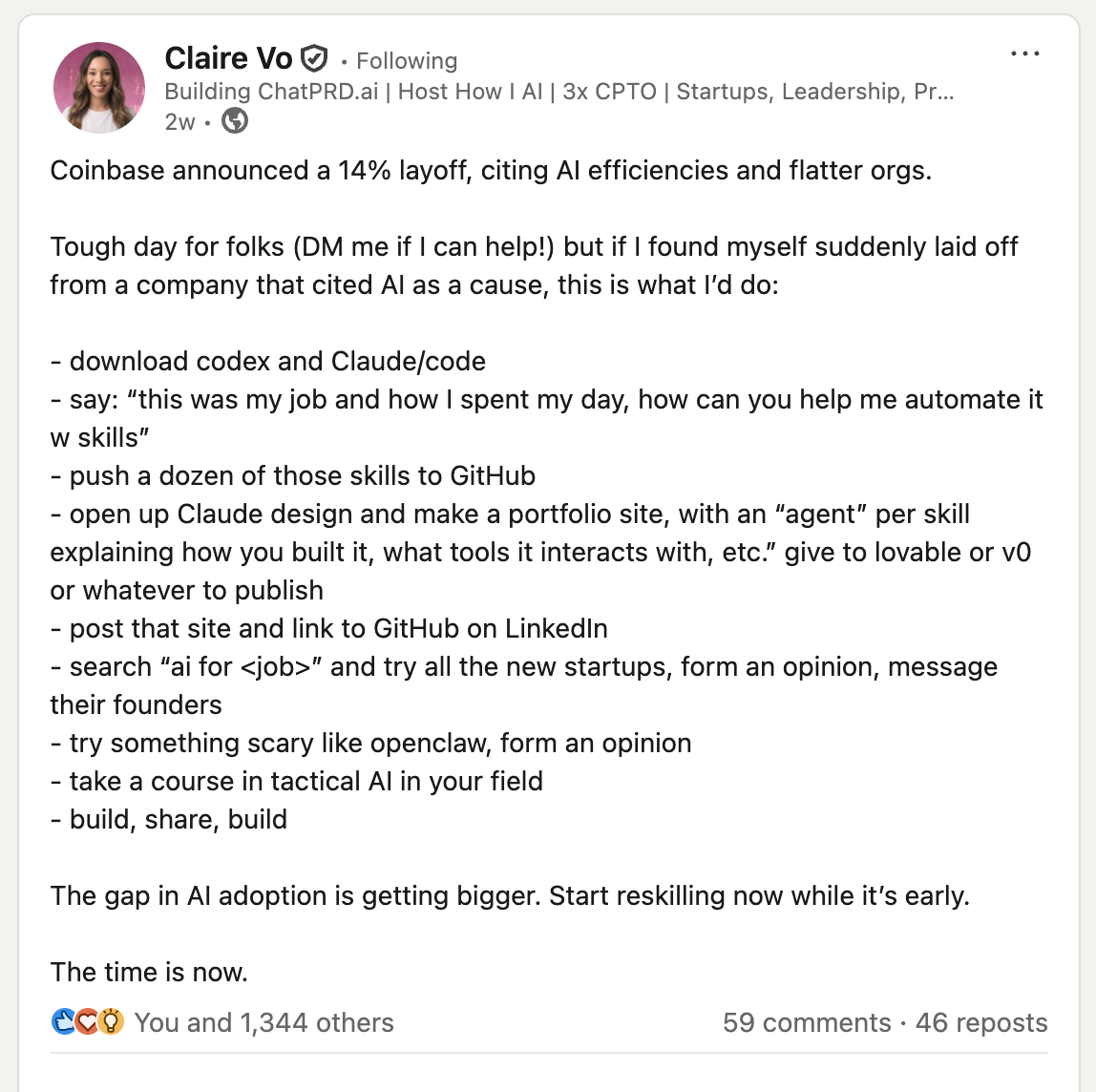
And if you’re looking for even more practical list of things to do tomorrow morning, I loved Claire Vo’s post about this:
So, you’re gonna lose your job. What are you going to do about it?
I hope you’ll take some time today to think seriously about what your role will look like in a year.
Even if you’re at the same company with the same title, I’d be shocked if you’re doing the same work.
After all, even I got ‘fired’ from my role as a manager a few months ago, to transition into doing IC work. You can’t avoid this kind of change. But there’s still time to prepare yourself. Ask yourself the tough questions, to decide what you really want to do and how you can prepare. Start your solopreneurship journey in some way, to give yourself career optionality. And start building an AI-native skillset, so you can thrive, no matter what.
Take one step toward each one of those. Then, go look at yourself in the mirror and tell yourself: ‘You’re gonna lose your job in 2027 and it’s gonna be your best year, yet.’
Edited by Jonathan Yagel (Fun fact: He built his new personal site with Lovable in an hour!)
There's a term in the industry: "AI washing". It's when a company lays people off because businesses isn't doing well and share prices are down and publicly explains it as "AI efficiency" to make it sound better to the stakeholders.
This post used a couple of confirmed AI washing examples as the evidence that jobs are becoming obsolete because of AI, including the one from Coinbase, where the so-called "AI efficiency layoff" coincided with the crypto market having been down for a while.
Then I googled the author. Head of growth at Lovable. A company whose entitire business model depends on convincing the public that their product can, somehow, replace real software engineers.
That explains it.
I’ve followed you, Elena, across platforms for a while, and a lot of your advice genuinely resonates with me. I also attended your AI-native talk and have been applying many of those learnings myself.
That’s why I agree with the core substance of this article. But I wish the piece also acknowledged the anxiety this kind of messaging creates for people already navigating layoffs, market shifts, and an ongoing identity crisis around work.
As a headline, the urgency works. But for many readers, the tone lands less as motivating and more as destabilizing. Not everyone reading this is complacent. Many are already doing everything they can to adapt.
I understand the value of reverse-engineering your mind. That mindset can absolutely push people to evolve faster. But there also needs to be space for the reality that even if someone does everything “right,” parts of their skill set may still become irrelevant. That’s the part people are quietly struggling with.